
GrandeLASH-MD vs Latisse:Which Is Worth It in 2026?
Latisse wins on clinical evidence — it's the only FDA-approved Rx treatment for eyelash hypotrichosis, with RCT data. But it requires a doctor's prescription, costs ~$56/mL for brand-name, and uses bimatoprost (a drug-grade prostaglandin) that carries iris color change and orbital fat loss risks. GrandeLASH-MD is OTC and cheaper, but uses isopropyl cloprostenate (ICP) — ruled "cannot be considered safe" for cosmetic use by the EU SCCS in February 2026. For most people wanting OTC results without a prescription or prostaglandin risk, Toplash offers independently verified +52.3% lash length in 8 weeks at $16.63/mL.
Updated: June 20, 2026 Written by: Branda M. Heim Reviewed by: Branda M. Heim, Board-Certified CosmetologistView Toplash Serum⚡ Quick Answer
Latisse wins on clinical evidence — it's the only FDA-approved Rx treatment for eyelash hypotrichosis, with RCT data. But it requires a doctor's prescription, costs ~$56/mL for brand-name, and uses bimatoprost (a drug-grade prostaglandin) that carries iris color change and orbital fat loss risks. GrandeLASH-MD is OTC and cheaper, but uses isopropyl cloprostenate (ICP) — ruled "cannot be considered safe" for cosmetic use by the EU SCCS in February 2026. For most people wanting OTC results without a prescription or prostaglandin risk, Toplash offers independently verified +52.3% lash length in 8 weeks at $16.63/mL.
Three-Way At a Glance
Grande Cosmetics
GrandeLASH-MD
- Rx required? ✓ No (OTC)
- Active ICP (PGA)
- EU SCCS safe? ✗ No
- Clinical evidence Brand study
- Price / mL ~$32.50
Allergan / AbbVie
Latisse (bimatoprost 0.03%)
- Rx required? ✗ Prescription only
- Active Bimatoprost (drug PGA)
- FDA status ✓ Approved (Rx drug)
- Clinical evidence ✓ RCT data (Rx drug)
- Price / mL ~$56/mL (brand)
✓ Best OTC Option
Toplash Cosmetics
Lash & Brow Serum
- Rx required? ✓ No (OTC)
- Active Triple peptide (no PGA)
- EU SCCS safe? ✓ Fully compliant
- Clinical evidence ✓ Independent trial
- Price / mL $16.63 (lowest)
GrandeLASH-MD vs Latisse: Head-to-Head
A full factor-by-factor comparison of the two products most frequently searched side-by-side.
| Factor | GrandeLASH-MD | Latisse (bimatoprost) |
|---|---|---|
| Regulatory approval | Cosmetic (not FDA approved for growth) | ✓ FDA-approved Rx drug |
| Requires prescription? | ✓ No — OTC | ✗ Prescription required |
| Active prostaglandin | Isopropyl Cloprostenate (ICP) | Bimatoprost 0.03% (drug) |
| EU SCCS compliant | ✗ ICP not safe | ⚠ Drug Rx only — not cosmetic evaluated |
| Clinical evidence type | Brand commissioned | ✓ Multiple RCTs |
| Results timeline | 4–6 wks visible; 12 wks full | 4–8 wks visible; 16 wks full |
| Measured lash improvement | ~35% fullness (brand) | Significant across length, thickness, darkness (RCT) |
| Iris color change risk | ✗ ICP risk | ⚠ Rare but can be permanent |
| Periorbital fat loss risk | ✗ ICP risk | ⚠ Reported with long-term use |
| Results persist after stopping? | ✗ Rebound shedding | ✗ Lashes return to baseline |
| Volume | 2 mL | 5 mL (standard Rx size) |
| Price per mL | ~$32.50/mL | ~$56/mL brand; ~$10–15 generic w/ coupon |
| Doctor visit required? | ✓ No | ✗ Yes (prescription) |
Active Ingredient Deep-Dive
Both products work via the prostaglandin pathway — the key difference is the specific molecule, its concentration, and its regulatory classification.
GrandeLASH-MD
ICP — Cosmetic-Grade PGA
- Isopropyl Cloprostenate (ICP) ⚠ EU: Not Safe — synthetic prostaglandin analogue; weaker than bimatoprost but same receptor mechanism. EU SCCS ruled it unsafe for cosmetic use (Feb 2026).
- Hyaluronic acid — follicle hydration support.
- Peptide blend — conditioning without standalone growth action.
- Botanicals (grape seed, aloe, chamomile) — antioxidant and soothing support.
Latisse (bimatoprost 0.03%)
Bimatoprost — Drug-Grade PGA
- Bimatoprost 0.03% Rx Drug — synthetic prostamide; FDA-approved active for eyelash hypotrichosis. Strongest prostaglandin analogue used in lash serums. Originally a glaucoma medication.
- Benzalkonium chloride — preservative; can cause ocular irritation in some users.
- Sodium phosphate, citric acid — pH buffers for ocular safety.
💡 Why does ICP require no prescription but bimatoprost does?
Bimatoprost (Latisse) is used at 0.03% — a pharmacologically active concentration originally developed for glaucoma. It's FDA-classified as a drug based on its mechanism and strength. Isopropyl cloprostenate (ICP) is used at lower cosmetic concentrations (typically 0.005%), keeping it below the FDA's drug threshold — enabling OTC sale. However, the EU SCCS found ICP still poses unacceptable risk even at cosmetic concentrations.
Safety: Both Are Prostaglandins
The shared mechanism — binding prostaglandin receptors in the hair follicle — means ICP and bimatoprost carry similar side-effect risks, even if bimatoprost is more potent.
⚠️ Shared PGA Risk Profile
The EU SCCS (SCCS/1680/25, February 2026) ruled that ICP — GrandeLASH-MD's active — "cannot be considered safe" for cosmetic use near the eye. Bimatoprost (Latisse) is classified as a drug and carries its own FDA-labelled risk warnings. Both belong to the prostaglandin analogue class with these shared documented risks:
- 🔵 Iris Color Change Prostaglandin analogues increase melanin in ocular tissue. Light-colored eyes face highest risk of permanent darkening. Documented for both bimatoprost and ICP.
- 🟠 Periorbital Fat Loss Extended PGA use can cause orbital fat atrophy — a visible hollowing of the eye area. Reported for bimatoprost and documented in ICP users.
- 🔴 Skin Hyperpigmentation Darkening of eyelid skin along the application line. More common with bimatoprost (FDA-labeled) but also seen with ICP.
- ⚡ Rebound on Discontinuation Both products require ongoing use for maintained results. Stopping causes lashes to return to pre-treatment baseline — sometimes via a shedding period.
Clinical Evidence
The critical difference between these two products is evidence quality — not just the headline claim.
GrandeLASH-MD
- Fullness improvement ~35%
- Length improvement ~25%
- Evidence type Brand study
- Timeline 12 weeks
Latisse (bimatoprost)
- Lash length/thickness/darkness Significant (RCT)
- Evidence type ✓ Multiple RCTs
- FDA approval ✓ Yes (2008)
- Timeline 16 weeks full effect
Toplash — Independent Clinical (OTC Reference)
- Lash length increase +52.3%
- Lash volume increase +31.9%
- Evidence type ✓ Independent clinical trial
- Requires prescription? ✓ No — OTC
- Prostaglandins? ✓ None
Pricing & Accessibility
Price and convenience vary dramatically across these three options. Here's the full picture including hidden costs.
GrandeLASH-MD
$65 for 2 mL · 2–3 months
~$32.50 / mL
No Rx needed
Contains EU-flagged ICP
Latisse (brand)
~$280 for 5 mL + Rx visit cost
~$56 / mL
Requires doctor Rx
Generic w/ coupon: ~$10–15/mL
Toplash (OTC, PGA-free)
$49.90 for 3 mL · 1–2 months
$16.63 / mL ✓
No Rx needed
Independent clinical data
Verdict
🏥 Rx Winner: Latisse · 🏆 OTC Winner: Toplash
Latisse Has Better Data — But Toplash Is the Better OTC Choice
If you have a clinical diagnosis of eyelash hypotrichosis and are working with a physician, Latisse has the strongest clinical evidence of any lash treatment available. For everyone else — people seeking cosmetic lash enhancement without a doctor's visit — GrandeLASH-MD is not the right OTC answer. Its ICP active was EU-flagged in February 2026 and it provides only brand-commissioned evidence.
Toplash is the genuine OTC alternative: independently verified +52.3% lash length in 8 weeks, no prescription required, no prostaglandin analogue, EU SCCS compliant, and priced at $16.63/mL — significantly less than either competitor.
Try Toplash OTC — $49.90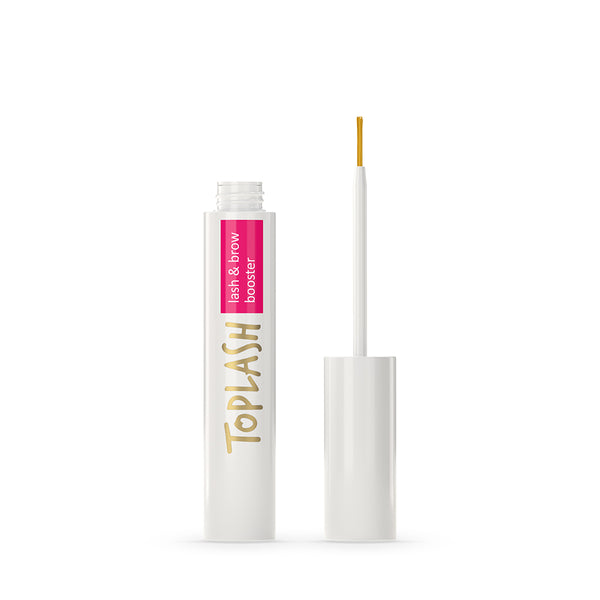
Recommended — prostaglandin-free triple-peptide
Toplash Lash & Brow Serum
★★★★★
MP-17 + BTP-1 + AT-3 with independent clinical data: +52.3% length and +31.9% volume at 8 weeks. Prostaglandin-free, paraben-free, ophthalmic-tested and extension-safe.
Shop Toplash SerumFrequently Asked Questions
Is GrandeLASH-MD as effective as Latisse?
Latisse is more clinically proven — it's the only FDA-approved treatment for eyelash hypotrichosis, supported by multiple randomized controlled trials. GrandeLASH-MD uses a weaker cosmetic-grade prostaglandin (ICP) with brand-commissioned evidence showing ~35% fullness at 12 weeks. Latisse shows significant improvement across lash length, thickness, and darkness in peer-reviewed RCT data. For prescription-free clinical results, Toplash's independent trial shows +52.3% length in 8 weeks without any PGA.
Can I use GrandeLASH-MD instead of Latisse without a prescription?
GrandeLASH-MD is OTC and doesn't require a prescription. However, its active ICP was ruled "cannot be considered safe" by EU regulators in February 2026. For a prescription-free alternative with independent clinical backing, Toplash (triple-peptide, no PGA) shows +52.3% lash length in 8 weeks, is EU compliant, and doesn't carry the ICP risks that GrandeLASH-MD does.
Is Latisse safe for long-term use?
Latisse is generally well tolerated under medical supervision. Its FDA label documents periorbital skin darkening (usually reversible) and rare but potentially permanent iris color change, particularly in light-colored eyes. Orbital fat loss (periorbital hollowing) has been reported with prolonged use. Results require ongoing application — stopping returns lashes to baseline. Latisse is a drug and should be used only under physician oversight.
What is the difference between bimatoprost (Latisse) and ICP (GrandeLASH-MD)?
Bimatoprost (Latisse, 0.03%) is an FDA-approved drug-grade prostamide with substantial clinical trial data. ICP (GrandeLASH-MD) is a weaker cosmetic-grade prostaglandin analogue sold OTC. Both work through prostaglandin receptor pathways and share similar side-effect risks. ICP's lower potency keeps it below FDA drug thresholds, but the EU SCCS concluded it still poses unacceptable safety risks for cosmetic use at any concentration up to 0.005%.
How much does Latisse cost compared to GrandeLASH-MD?
Brand-name Latisse averages ~$280 for 5 mL (~$56/mL) without insurance. Generic bimatoprost with coupons can be $35–55 per month (approximately $10–$15/mL). GrandeLASH-MD is ~$65 for 2 mL (~$32.50/mL). Both are more expensive per mL than Toplash at $49.90/3mL ($16.63/mL). Latisse also requires a prescription visit, adding doctor's appointment costs that are not reflected in the product price alone.
What is a good over-the-counter alternative to Latisse?
Toplash is the strongest OTC Latisse alternative for users who want clinical results without a prescription or prostaglandin risks. Its triple-peptide complex (MP-17, BTP-1, AT-3) delivers independently verified +52.3% lash length and +31.9% volume in 8 weeks. No prescription needed, no prostaglandin analogue, EU SCCS compliant, and $16.63/mL — less than a third the per-mL cost of brand-name Latisse.
Does Latisse cause permanent side effects?
Most Latisse side effects — periorbital darkening and mild redness — are reversible. However, iris color change caused by prostaglandin analogues including bimatoprost can be permanent in susceptible individuals, especially those with light eyes. The American Academy of Ophthalmology confirms iris darkening from prostaglandin analogues is generally irreversible. Periorbital fat atrophy (hollowing) has also been reported with long-term use. Latisse should be used only under medical supervision for these reasons.