
Lash Serum Irritation: Causes, Types, Treatment & When to See a Doctor (2026)
Red, itchy, burning eyes from a lash serum? Learn the two types of reaction — irritant vs allergic contact dermatitis — which ingredients cause each, how to treat them, and how to choose a serum that avoids both.
Updated: June 20, 2026 Written by: Branda M. Heim Reviewed by: Branda M. Heim, Board-Certified Cosmetologist9 referencesView Toplash SerumQuick Answer
Lash serum irritation is caused by one of two mechanisms: irritant contact dermatitis (immediate burning from alcohol, fragrance, BAK or prostaglandins) or allergic contact dermatitis (delayed immune response 24–72 hours after exposure, triggered by sensitising allergens like parabens or fragrance compounds). Stop the serum, cool-rinse the area, and see a dermatologist or ophthalmologist if symptoms persist beyond 48 hours.
The periorbital skin is among the thinnest and most reactive tissue in the body. It is approximately 0.5 mm thick — less than one-third the thickness of facial skin — making it uniquely susceptible to both chemical irritation and allergic sensitisation. When a lash serum causes irritation, the reaction is almost always one of two dermatological patterns, each with a distinct cause, timeline and treatment approach.
Two Types of Lash Serum Reaction
Type 1
Irritant Contact Dermatitis
- Caused by direct chemical damage to skin barrier
- Onset: within 30–60 minutes of application
- Does not require prior sensitisation
- Proportional to dose and exposure duration
- Common triggers: alcohol, fragrance, BAK, prostaglandins
- Stops worsening when product is stopped
- Usually resolves within 2–5 days of stopping
Type 2
Allergic Contact Dermatitis
- Immune-mediated Type IV (delayed) hypersensitivity
- Onset: 24–72 hours after exposure
- Requires prior sensitisation (often a previous product)
- Can worsen with repeated exposure at low doses
- Common triggers: fragrance compounds, parabens, ICP
- May cross-react with other cosmetic allergens
- May require prescription treatment for resolution
A key diagnostic clue: irritant reactions are immediate (you feel burning shortly after application); allergic reactions are delayed (you wake up the next morning to swollen, itchy eyelids). Both can co-exist in the same user.
Recognising the Symptoms
Lash serum irritation manifests across a spectrum of severity. Mild symptoms are common in the first few days of a new formula; persistent or moderate-to-severe symptoms signal incompatibility:
Mild Transient Stinging
Brief burn for 1–5 minutes post-application; resolves spontaneously. Common in first 1–3 days.
Eyelid Dryness
Tight, dry feeling; mild flaking. Often caused by alcohol content disrupting lipid barrier.
Persistent Redness
Red, bloodshot eye or pink eyelids lasting more than a few hours. Indicates chemical irritation or mild allergy.
Itching
Persistent periorbital itch, especially if delayed from application — characteristic of allergic contact dermatitis.
Eyelid Swelling
Puffy or swollen eyelid skin; may appear in the morning after overnight application. Stop use if this occurs.
Severe Oedema / Discharge
Significant lid swelling affecting eye opening; any discharge or crusting. Requires same-day medical attention.
Which Ingredients Cause Lash Serum Irritation?
Five ingredient categories account for the vast majority of lash serum reactions. Understanding which are in your product — and how they cause reactions — is the most direct path to prevention:
| Ingredient | INCI Name(s) | Reaction Type | Irritation Level |
|---|---|---|---|
| Prostaglandin analogs | Isopropyl Cloprostenate, DDDE, MDN, Bimatoprost | Both irritant (acute) and pharmacological (conjunctival hyperemia) | High |
| Benzalkonium chloride (BAK) | Benzalkonium Chloride | Irritant — disrupts tear film lipid layer, damages corneal epithelium | High |
| Synthetic fragrance | Parfum, Fragrance, Linalool, Limonene, Citronellol | Allergic — top periorbital allergen group in patch test literature[1] | High |
| Denatured alcohol | Alcohol Denat., SD Alcohol 40, Ethanol | Irritant — disrupts lipid barrier, increases permeability to other irritants | Moderate |
| Parabens | Methylparaben, Propylparaben, Butylparaben | Allergic — sensitiser; causes delayed Type IV hypersensitivity reactions | Moderate |
| Peptide complexes (MP-17, BTP-1, AT-3) | Myristoyl Pentapeptide-17, Biotinoyl Tripeptide-1, Acetyl Tetrapeptide-3 | No known irritant or allergic mechanism at cosmetic use concentrations | Minimal |
The 2026 EU SCCS Opinion SCCS/1680/25 concluded that prostaglandin compounds ICP, DDDE and MDN are unsafe for cosmetic use, specifically citing ocular irritation among the documented adverse effects.[2]
How to Treat Lash Serum Irritation
The treatment approach differs based on whether you are addressing an irritant or allergic reaction, and whether the reaction is mild or more significant:
Immediate First-Response Steps (Any Reaction)
- Stop the lash serum immediately. Do not attempt to "push through" irritation. Continued use will worsen both irritant and allergic reactions. Set the product aside — do not discard it yet, as you may need to check the INCI list with a dermatologist.
- Rinse the area with cool, clean water. Gently splash cool water around the eye area for 60 seconds to dilute and remove residual serum. Do not rub — this will further disrupt the skin barrier and spread the irritant.
- Apply a cool compress. A clean cloth soaked in cool water (not ice) applied to closed eyelids for 10–15 minutes reduces inflammation, soothes stinging and constricts superficial blood vessels to reduce redness.
- Cleanse gently with a fragrance-free, gentle cleanser. Remove any remaining product with a gentle, fragrance-free micellar water or oil cleanser. Avoid foaming cleansers with sulphates in the periorbital area during the recovery period.
- Pause all other eye-area products for 48–72 hours. Retinol, AHAs, vitamin C, and most eye creams contain additional potential irritants. Allow the periorbital skin to recover with only cool water and a fragrance-free, alcohol-free moisturiser for the first 2–3 days.
For Persistent or Allergic Reactions
If symptoms do not improve substantially within 48 hours of stopping the product, seek a dermatology or ophthalmology consultation. A dermatologist can:
- Prescribe a short course of topical corticosteroid (e.g. dexamethasone ointment, 1% hydrocortisone) to reduce inflammation
- Perform patch testing to identify the specific allergen — essential if you want to choose a future serum safely
- Refer to an ophthalmologist if the eye surface itself (not just eyelid skin) is involved
🚨 See a Doctor Same-Day or Next-Day If:
- Eyelid swelling is significant enough to limit eye opening
- Any discharge, watering or crusting from the eye itself (not just eyelid)
- Eye pain or any change in vision
- Symptoms spreading beyond the periorbital area to the cheek or brow
- Any change in iris colour
- Symptoms do not improve after 48 hours of stopping the serum
"The periorbital area is the most reaction-prone site in cosmetic use — thin skin, close proximity to the ocular surface, and a uniquely exposed immune environment. When a lash serum causes irritation, the most important first step is always to stop and allow recovery. Choosing a formula that eliminates the five primary sensitising categories eliminates the majority of risk before it starts."
How to Patch Test a Lash Serum
For anyone with a history of skin sensitivity or prior cosmetic reactions, a patch test before starting a new lash serum reduces but does not eliminate risk. Note that periorbital skin is more sensitive than the test sites typically used:
- Apply a small amount of the serum to the inside of the forearm (not near the eye).
- Leave uncovered and undisturbed for 48 hours.
- Check for redness, raised skin, itching or swelling at the test site.
- If no reaction occurs, the product is less likely to cause an allergic reaction (though individual periorbital responses can still differ).
- If any reaction occurs, do not use the product on the lash line.
A clean patch test is reassuring but not absolute — periorbital skin is up to 6× more permeable than inner forearm skin and has direct access to the ocular mucosa. Start any new serum at every-other-day frequency regardless of patch test results.
Choosing a Low-Irritation Lash Serum
The simplest strategy for avoiding lash serum irritation is choosing a formula that eliminates all five primary sensitising categories. Toplash is formulated without:
- Prostaglandin analogs (ICP, DDDE, MDN, bimatoprost)
- Synthetic fragrance (fragrance-free)
- Benzalkonium chloride (BAK)
- Denatured alcohol
- Parabens and phthalates
Its triple-peptide complex (MP-17, BTP-1, AT-3) has no known irritant or sensitising mechanism at cosmetic concentrations. In an independent 8-week trial, +52.3% lash length and +31.9% volume were recorded with no ocular or periorbital adverse events reported.[3]
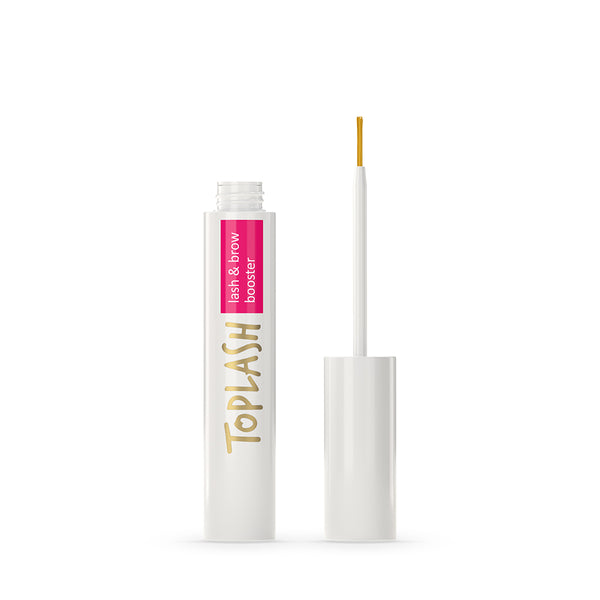
Recommended alternative — complete triple-peptide system
Toplash Lash & Brow Serum
★★★★★
The complete AT-3 + BTP-1 + MP-17 growth-peptide system with independent clinical data: +52.3% length and +31.9% volume at 8 weeks. Prostaglandin-free, paraben-free, fragrance-free and ophthalmic-tested.
Shop Toplash SerumFrequently Asked Questions
Why is my lash serum causing irritation?
Lash serum irritation has two main causes: irritant contact dermatitis from chemical irritants (alcohol, fragrance, BAK, prostaglandins) — usually immediate within 30–60 minutes; or allergic contact dermatitis — a delayed immune response appearing 24–72 hours after exposure, triggered by sensitising allergens like parabens or fragrance compounds. Stop the serum and monitor which pattern fits your reaction.
What are the symptoms of lash serum irritation?
Symptoms include: burning or stinging (especially within 30 minutes of application); redness or bloodshot eyes; itching around the eyelids; swelling of the eyelid skin; dryness or flaking; watery eyes. Severe symptoms include significant eyelid oedema, discharge, or crusting — seek same-day medical attention for these.
What is the difference between irritant and allergic contact dermatitis from lash serum?
Irritant: direct chemical damage; immediate onset within hours; proportional to dose; stops worsening when product is stopped. Allergic: immune-mediated; delayed 24–72 hours; can worsen with each exposure even at low doses; requires patch testing to identify the allergen. Irritant reactions are more common; allergic reactions can be more persistent.
How do I treat lash serum irritation?
Stop the serum immediately. Rinse the area with cool water for 60 seconds. Apply a cool compress for 10–15 minutes. Use a fragrance-free gentle cleanser to remove residue. Pause all other eye-area products for 48–72 hours. If symptoms persist beyond 48 hours, see a dermatologist — topical corticosteroids may be needed for allergic reactions.
When should I see a doctor for lash serum irritation?
Seek medical attention if: symptoms persist more than 48 hours after stopping; swelling limits eye opening; discharge or crusting occurs from the eye; there is eye pain or visual change; symptoms spread beyond the eye area; or any iris colour change is noticed. These warrant same-day or next-day clinical assessment.
Can I do a patch test before using a lash serum?
Yes — apply to the inner forearm and wait 48 hours. Redness, itching or swelling indicates potential sensitisation. Note that periorbital skin is significantly more sensitive than forearm skin, so a clean patch test is reassuring but not a guarantee. Start any new serum at every-other-day frequency for the first two weeks regardless.
Which lash serum is least likely to cause irritation?
A formula free of all five primary irritant categories: prostaglandin analogs, synthetic fragrance, BAK, denatured alcohol, and parabens/phthalates. Toplash contains none of these and uses peptide actives (MP-17, BTP-1, AT-3) which have no known irritation mechanism at cosmetic concentrations. No ocular or periorbital adverse events were reported in its 8-week clinical trial.
References
- Warshaw EM, et al. "Eyelid Contact Dermatitis: 25-Year Single-Center Retrospective Study." J Am Acad Dermatol. 2025. PMC11818699.
- Scientific Committee on Consumer Safety. Opinion SCCS/1680/25 on Isopropyl Cloprostenate, DDDE and MDN in cosmetic products. European Commission; 2 February 2026. View PDF
- Toplash Cosmetics. Internal clinical trial data, 8-week independent study. 2025.
- Cleveland Clinic. "Eyelid Dermatitis: Contact, Symptoms, Causes, Treatment." 2024.
- Optometry Times. "A closer look at periorbital allergic dermatitis." 2024.
- Ophthalmology24. "Lash Serum in the Eye: Risks and Irritation." 2025.
- Peep Club. "Can Eyelash Growth Serums Damage Your Eyes?" 2025.
- Centers for Dry Eye. "Can Eyelash Serum Cause Blepharitis?" 2024.
- Eastern Curlew. "Is Your Eyelash Serum Causing Irritation: Tips to Resolve It." 2025.