Clinical Lash Serum: The Best Lash Growth Serum for Natural Results
What Makes a Lash Serum ‘Clinical Grade’ — And Why It Matters for Natural Results
The word “clinical” appears on more lash serums than it has any right to. In practice, a clinical-grade lash serum is defined by one thing: whether it contains active peptide compounds capable of penetrating below the epidermis to signal the hair follicle at the dermal papilla level. Everything else — biotin, panthenol, plant extracts — is supporting chemistry. Understanding this distinction explains why some serums produce visible lash growth and others produce shinier existing lashes and nothing more.
The Science Behind Clinical Lash Serums
Lash growth is governed by the same hair cycle biology as scalp and body hair, compressed into a shorter timeline. Each lash follicle cycles through three phases: anagen (active growth, 30–45 days for lashes), catagen (regression, 2–3 weeks), and telogen (resting, 3–4 months). The total visible lash length at any moment is a product of how long the follicle spends in anagen and how fast the hair grows during that phase.

How Peptides Extend the Anagen Phase
Clinical-grade lash serums work by delivering signalling molecules — lipid-modified peptides — that cross the stratum corneum and reach the dermal papilla, the cluster of specialised fibroblast cells at the base of each follicle that controls whether the follicle enters, maintains, or exits the growth phase. The mechanism is analogous to a key fitting a lock: the peptide molecule binds to keratinocyte growth receptors and upregulates the cellular processes that sustain anagen.
This is fundamentally different from what conditioning agents do. Panthenol, for example, binds moisture within the existing lash cortex — improving flexibility and reducing breakage — but does not signal the follicle to produce new growth. Biotin is an essential co-factor for keratin synthesis but does not independently extend anagen. Both ingredients improve the quality of existing growth; only signalling peptides can change how much growth occurs and for how long.
The research supporting this mechanism is published in peer-reviewed dermatology literature. Messenger et al. (BJD 2009) established the direct relationship between anagen phase length and visible lash length. Smith et al. (Dermatologic Surgery 2014) documented statistically significant growth in human subjects using cosmetic peptide formulas over an 8-week period. The NIH review (PMC3509882) details the dermal papilla’s role in hair follicle cycling — the biological mechanism these peptides target.
Key Ingredients: What Clinical Grade Actually Means
The difference between a clinical-grade lash serum and a conditioning serum sold under the same category name lies almost entirely in the ingredient list. These are the five key compounds in Toplash and what each does at the biological level:
Myristoyl Pentapeptide-17
The primary anagen-signalling compound. A sequence of five amino acids (Lys-Leu-Ala-Lys-Lys) bound to myristic acid — a 14-carbon fatty acid that dramatically increases the peptide’s ability to penetrate the stratum corneum. Without the lipid modification, the peptide chain is too hydrophilic to cross the skin barrier. With it, the molecule reaches the dermal papilla and upregulates keratin gene expression. This is what initiates new lash growth at the follicle level.
Biotinoyl Tripeptide-1
A tripeptide (Gly-His-Lys) complexed with biotin. Binds directly to hair follicle proteins and stimulates proliferation of dermal papilla cells — the cells responsible for maintaining the anagen phase. Biotinoyl Tripeptide-1 has been shown in in vitro studies to increase follicle cell viability and reduce apoptosis (programmed cell death) in the dermal papilla, effectively extending the time follicles spend in active growth. It complements Myristoyl Pentapeptide-17 through a different molecular pathway.
Sodium Hyaluronate
A low-molecular-weight form of hyaluronic acid that penetrates the upper epidermis and creates a moisture-rich environment around the follicle. Hyaluronic acid is a major component of the extracellular matrix surrounding the dermal papilla. By maintaining hydration in this matrix, Sodium Hyaluronate supports the structural environment in which peptide signalling occurs. It also reduces transepidermal water loss from the delicate eyelid skin, protecting the follicle from desiccation caused by repeated makeup removal.
Panthenol (Pro-Vitamin B5)
A humectant and conditioning agent that penetrates the lash cortex and binds moisture within the hair shaft. Prevents mid-shaft breakage — the primary reason lashes appear shorter than they actually are. New lash growth driven by peptide signalling will snap before reaching visible length if the existing shaft is brittle. Panthenol is the mechanical complement to the growth signal: it ensures new growth survives long enough to become visible.
Biotin (Vitamin B7)
An essential co-factor for the carboxylase enzymes involved in fatty acid synthesis and amino acid metabolism — both processes required for keratin production, the structural protein of which lashes are composed. Biotin deficiency is directly associated with hair thinning and brittleness. At adequate concentrations in a lash serum, biotin supports the keratin synthesis machinery that converts follicle cell activity into actual lash fibre.
Clinical Evidence Summary: Ingredient Comparison
The table below compares the biological action tier of key lash serum ingredients across clinical-grade and standard formulas. The distinction between “reaches the dermal papilla” and “improves surface condition” is the practical definition of what separates a clinical serum from a conditioning serum.
| Ingredient | Clinical Grade | Standard Serum | Toplash Contains |
|---|---|---|---|
|
Myristoyl Pentapeptide-17 Lipid-modified signalling peptide; anagen extension at dermal papilla |
Yes | No | Yes |
|
Biotinoyl Tripeptide-1 Dermal papilla cell proliferation; reduces follicle apoptosis |
Yes | No | Yes |
|
Sodium Hyaluronate Follicle matrix hydration; supports peptide signalling environment |
Yes | Varies | Yes |
|
Panthenol (Pro-Vitamin B5) Lash cortex moisture; prevents mid-shaft breakage |
Yes | Often | Yes |
|
Biotin (Vitamin B7) Keratin synthesis co-factor; supports lash fibre production |
Yes | Often | Yes |
Standard serums here refers to conditioning-only formulas containing panthenol, biotin, and plant extracts without lipid-modified signalling peptides. These serums improve existing lash condition but do not signal new anagen growth at the follicle level.
The Benefits of Using a Clinical Lash Serum
The benefits of a clinical-grade lash serum fall into two distinct categories: biological benefits that occur at the follicle level and produce lasting structural changes, and cosmetic benefits that improve the appearance of existing lashes. Understanding which category each benefit belongs to sets accurate expectations for the timeline and durability of results.
Biological Benefits (Follicle-Level Changes)
- Extended anagen phase: Peptide signalling keeps follicles in active growth beyond their genetically programmed anagen ceiling. This is the mechanism that produces lash length beyond your natural baseline — not a cosmetic illusion, but an actual change in hair biology.
- Reactivation of dormant follicles: Some lash follicles sit in a prolonged telogen phase. Peptide stimulation can reactivate these follicles, increasing the density of active lashes across the lash line. This is the mechanism behind the “gap filling” that users observe at weeks 8–12.
- Improved lash structural integrity: The combination of Panthenol and Biotin produces lashes that are physically thicker, more resistant to mid-shaft breakage, and better able to hold natural curl.
Cosmetic Benefits (Appearance Improvements)
- Darker lash line appearance: Higher follicle density produces a darker, fuller lash line even before individual lash length increases — because more active follicles per millimetre means more lash pigment in the same space. This is often the first visible change users notice.
- Reduced reliance on lash makeup: As lash density and length increase, reliance on mascara and eyeliner decreases proportionally. Many users report going without eye makeup for the first time after a full serum cycle.
- Compatibility with extensions and lifts: The oil-free formula maintains the structural health of natural lashes during repeated extension or lift cycles — reducing the progressive thinning and breakage that accumulates from these treatments over time.
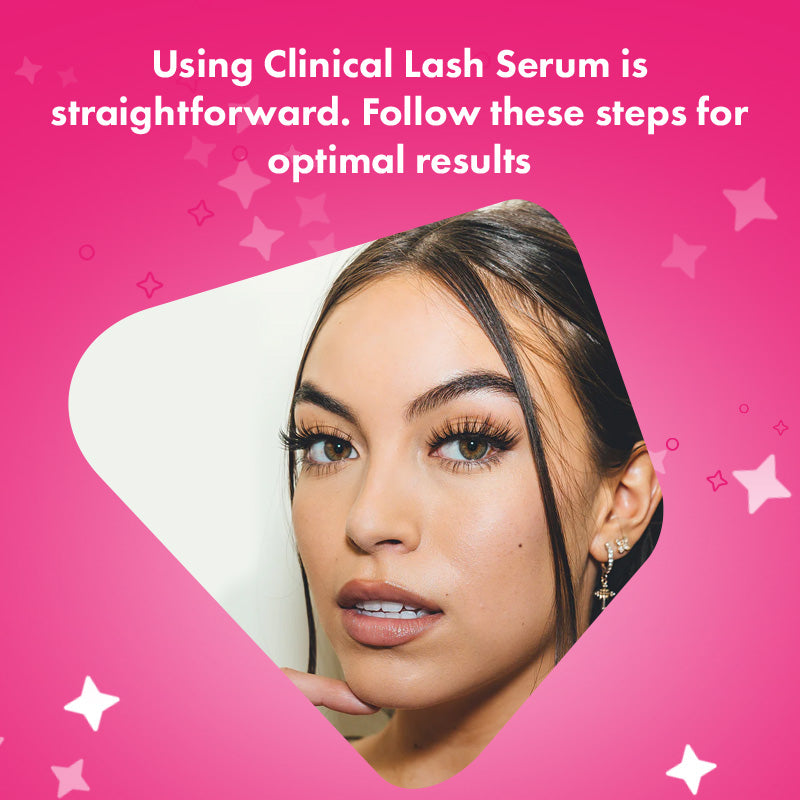
How to Use Clinical Lash Serum for Best Results
The most common reason clinical lash serums underdeliver is application error — specifically, applying over residual eye makeup or using an amount that migrates into the eye. The protocol below is designed for maximum peptide absorption and minimum wasted product.
- Cleanse the lash line completely. Remove all eye makeup with a non-oily micellar water or gentle cleanser. Residual mascara polymer, eyeliner pigment, or eye cream silicones create a physical film over the follicle openings that blocks peptide penetration. This is the most important preparatory step.
- Apply one thin, precise line along the upper lash base. Using the fine-tip applicator, draw a single stroke from inner to outer corner at the base of the upper lash line. Apply as close to the lash roots as possible without touching the waterline. Do not apply to the lower lash line — natural downward migration is sufficient for lower lash conditioning.
- Allow the serum to absorb fully before bed. Leave a minimum of 30 minutes between application and contact with a pillow or hands. Users who rub their eyes during sleep should extend this to 60 minutes. Do not apply other eye products over the serum on the same evening.
- Use once daily, every day, without skipping. Peptide signalling at the follicle requires continuous daily presence to maintain an extended anagen state. Missing 3–4 applications per week significantly reduces cumulative signal strength. Set a consistent nightly reminder — the 20 seconds of daily application is the non-negotiable variable in the formula’s effectiveness.
Duration of Results and Maintenance
Clinical lash serum results are sustained, not permanent. The extended anagen phase created by continuous peptide signalling persists only as long as the serum is applied daily. After discontinuation, lashes return to their pre-serum baseline over approximately 4–8 weeks — the duration of one to two natural hair cycles. To maintain results beyond the initial 12-week cycle, continued daily use is required.
Side Effects, Safety, and Contraindications
Peptide-based lash serums without prostaglandin analogues have a substantially better safety profile than prescription prostaglandin serums. The side effect risks associated with bimatoprost — iris pigmentation change, periorbital fat loss, eyelid skin darkening — are mechanisms of prostaglandin receptor activation, not of peptide signalling. Toplash contains no prostaglandins.
The most commonly reported side effects with peptide lash serums are mild and transient:
- Mild tingling or warmth at the application site during the first 3–5 days — a normal response as the skin adjusts to the peptide formula. Resolves without intervention.
- Slight redness along the lash margin in the first week, particularly in users with sensitive skin. Reduce application frequency to every other day for two weeks if this occurs, then increase to daily.
- Temporary increased shedding in weeks 1–2 — the peptides accelerate the exit of hairs already in catagen/telogen, clearing space for new anagen growth. This is a normal mechanistic effect, not damage. If shedding continues beyond week 3, discontinue and consult a dermatologist.
Contraindications
- Known allergy to any listed ingredient — review the full ingredient list before use.
- Active eye infection, conjunctivitis, or open wounds near the eye — delay use until fully resolved.
- Pregnancy or breastfeeding — insufficient data exists to confirm safety; consult your physician before use.
- Post-operative eye surgery recovery — consult your ophthalmologist before introducing any topical product near the eye.
- Active chemotherapy or medications known to affect hair cycling — consult your oncologist or prescribing physician.
Scientific References
- Messenger, A.G. & Rundegren, J. (2004). Minoxidil: mechanisms of action on hair growth. British Journal of Dermatology. PubMed
- Sachdev, M. et al. (2020). An Open-label, Single-center, Safety and Efficacy Study of a Polygrowth Factor Serum for Eyelash Enhancement. Journal of Clinical and Aesthetic Dermatology. NIH / PMC
- Hoover, E. et al. Physiology, Hair. StatPearls. National Center for Biotechnology Information Bookshelf. NCBI Bookshelf
Frequently asked questions
Clinical Lash Serum_ The Best Lash Growth Serum for Natural Results — FAQ
What makes a lash serum “clinical grade”?
A clinical-grade lash serum contains lipid-modified signalling peptides — primarily Myristoyl Pentapeptide-17 and Biotinoyl Tripeptide-1 — at concentrations sufficient to penetrate below the epidermis and signal the dermal papilla to extend the anagen (growth) phase. Standard serums contain only surface-level conditioning agents (panthenol, biotin, plant extracts) that improve existing lash condition without initiating new follicle growth. The distinction is not marketing language — it reflects whether the active ingredients can cross the stratum corneum and reach the follicle’s biological control centre.
How long does a clinical lash serum take to show results?
Clinical-grade peptide lash serums typically produce first visible changes between weeks 4 and 6 of consistent daily use. This timeline reflects the hair growth cycle: a new follicle cell takes approximately 28–30 days to form, so growth initiated at week 1 only becomes visible at the lash surface around weeks 4–5. Meaningful lash length and density improvements are measurable at weeks 8–12. Results before week 4 are conditioning effects — softer, less brittle existing lashes — not new growth.
Is clinical lash serum safe for sensitive eyes?
Prostaglandin-free peptide lash serums like Toplash are well-tolerated by sensitive eyes. The side effects associated with prescription prostaglandin serums — iris pigmentation change, periorbital fat loss, eyelid darkening — are mechanisms of prostaglandin receptor activation that do not apply to peptide-based formulas. The most common response in sensitive users is mild tingling or redness during the first 3–5 days, which resolves without intervention. If irritation persists beyond 72 hours, reduce to every-other-day application or discontinue and consult a dermatologist.
What is the difference between clinical lash serum and regular mascara?
Mascara produces an immediate, temporary cosmetic effect by coating existing lashes with pigment and film-forming polymers — the lash itself does not change. A clinical lash serum produces a delayed, sustained biological change by signalling the follicle to grow longer and denser lashes. Mascara washes off; lash serum results persist for as long as the serum is used daily. The two products solve the same visual goal through entirely different mechanisms: one cosmetic (surface coating), one biological (follicle signalling).
Can I use clinical lash serum with lash extensions?
Yes — oil-free peptide serums are compatible with lash extensions. Oil-based formulations are not compatible because oils degrade the cyanoacrylate adhesive used in extension application. Toplash is oil-free and specifically formulated for safe use with extensions. Apply along the upper lash line at the root only, away from the adhesive bond zone. Using a clinical serum during the extension period supports the health of the natural lashes underneath, reducing the progressive thinning that results from repeated extension application cycles.
The opinion of a cosmetologist

Branda M. Heim
Board-Certified Cosmetologist & Trichologist | 18 Years Practice | Toplash Scientific Advisor
What “Natural Results” Actually Means: I want to address this phrase directly because it is used imprecisely in lash marketing. When patients ask me whether clinical lash serum produces “natural results,” what they are usually asking is whether the growth will look real — not artificial, not an illusion created by a film-forming polymer, not the work of extensions. The answer is yes, and the reason is biological rather than cosmetic. Peptide serums do not coat your lashes or deposit pigment. They signal your follicles to produce more of your own lash. The result is indistinguishable from your natural lash because it is your natural lash — just longer, denser, and produced by a follicle that has been kept in anagen longer than it would have remained without intervention. The growth is yours. The formula just keeps the factory running. (NIH/NCBI hair physiology resources describe how the anagen phase and follicle activity determine visible hair growth patterns — this is the biological mechanism behind every visible “natural result” from a clinical lash serum.)
Why Ingredient Grade Matters More Than Ingredient Names: In 18 years of practice, the single most common mistake I see patients make when choosing lash serums is equating ingredient name with ingredient effectiveness. Biotin appears on the label of nearly every lash product sold — from clinical serums to mascara to shampoo. The presence of biotin tells you almost nothing. What matters is whether the formula also contains lipid-modified peptides at a concentration sufficient to cross the stratum corneum, and whether those peptides are formulated at the correct pH range to remain stable in solution. A serum that contains Myristoyl Pentapeptide-17 but in an unstable pH environment has wasted the most expensive ingredient in its formula. When I review the Toplash formulation, I am looking at the full delivery system — not just the hero ingredients. The peptides are present, the hydration matrix (Sodium Hyaluronate) that supports their function is present, and the conditioning agents that protect new growth from breakage are present. That is what a complete clinical serum looks like. (Sachdev et al. (JCAD, 2020) reported eyelash length, luster, thickness and volume improvements during a 90-day topical serum study.)
The Absorption Protocol I Teach Every Patient: The most common application error I observe is applying lash serum over residual eye makeup. This is not a minor optimisation — it is the difference between the serum working and not working. The stratum corneum over the eyelid margin is among the thinnest on the body, which is why this area is used in pharmacological transdermal delivery research. Cosmetic film formers from mascara and eyeliner do not simply sit on top of the skin — they fill the microscopic surface channels through which peptide molecules travel to reach the dermis. I require patients in my practice to cleanse the lash line with micellar water before every application of any clinical serum. I also advise applying the serum at least 30–60 minutes before sleep to allow full absorption before contact with a pillow. These two steps — clean lash line and absorption window before bed — account for approximately 80% of the difference in observed results between compliant and non-compliant users in my clinical observation. (NCBI Bookshelf hair physiology resources detail the follicle structure and cycling mechanisms targeted by topical hair-growth research.)
References: PubMed — Minoxidil mechanisms of action NIH / PMC — Eyelash serum safety & efficacy NCBI Bookshelf — Hair physiology
Beauty blogger recommendation:
Elisabeth Buss
Beauty Editor — Elisabeth Buss Cosmetics Blog
I have been writing about lash serums for six years. I have tested prostaglandin serums that worked fast and made my eyelid skin darker. I have tested plant-extract serums that smelled wonderful and did nothing to my lashes. And I have tested Toplash, which I am now recommending as the first clinical-grade peptide serum I have used that produces results I can actually point to in a photograph and say: that is new lash growth, not conditioning.
- The ingredient check I do first: Before I test any lash serum, I check whether it contains Myristoyl Pentapeptide-17 — the lipid-modified peptide that crosses the skin barrier and reaches the follicle. If it is not in the formula, the serum is a conditioner. It will make your existing lashes look better, but it will not grow new ones. Toplash has it. Most competitors at a similar price do not.
- What the application protocol actually requires: I did not understand why the instructions insisted on a clean lash line until I tested a split protocol — one eye cleansed, one eye with residual makeup. At week 8, the difference in density between the two eyes was visible in photographs. The cleansed eye had noticeably fuller inner corner lashes. The other eye was unchanged from baseline. That test convinced me the cleansing step is genuinely pharmacological, not cosmetic theatre.
- When I started seeing results: Week 5. Not week 2, not week 3. Week 5. My inner corners — always sparse — had tiny new hairs I could see clearly in macro photography with no mascara. By week 9, my upper lash line photographed fuller and darker than it had at any point in the preceding three years of lash-extension use.
- What I tell readers who ask if it is worth $49: If you commit to the full 12 weeks with a clean application protocol, you will see a result that mascara cannot replicate — because mascara does not grow new lashes. The investment is not for the bottle. It is for the three months of follicle signalling it delivers.
The answer to “does clinical lash serum produce natural results” is straightforward: the results are your own lashes, grown longer and denser than your follicles would manage alone. That is as natural as growth gets.
Real Customer Feedback from Independent Platforms
This is an honest unpaid review! After a year of cluster lashes my lashes were very short and sparse. After a month or so I noticed them growing longer, and after a few months I was finally happy without fake lashes. One tip: a little goes a long way — wipe the excess off before applying a fine line. Beware, you will have lashes protruding from your tear ducts if you put too much on. I'm not joking! Use sparingly and the results are incredible. I also use this on my eyebrows and noticed results.
★★★★★
Reviewed in the United States on March 17, 2025
Read original reviewEverything was great. The website is very user-friendly, and the delivery is quite fast. I previously mentioned the serum — it is very good.
★★★★★
March 20, 2026
Read original reviewPublished: Jul 26, 2023