
Peptide Lash Serum: How It Works, Key Ingredients & Clinical Results (2026)
What is a peptide lash serum, how do peptides like MP-17, BTP-1 and AT-3 grow eyelashes, and what results can you expect? Complete science-backed guide with clinical evidence, 2026.
Updated: June 20, 2026 Written by: Branda M. Heim Reviewed by: Branda M. Heim, Board-Certified Cosmetologist8 referencesView Toplash SerumA peptide lash serum uses short amino acid chain molecules as active growth signals. MP-17 (Myristoyl Pentapeptide-17) upregulates keratin gene expression in follicle cells. BTP-1 (Biotinoyl Tripeptide-1) strengthens follicle anchoring and reduces premature shedding. AT-3 (Acetyl Tetrapeptide-3) prevents follicle miniaturisation. Together, these produce measurably longer, denser lashes over 8–12 weeks — without prostaglandins and without pharmacological risk to the eye.
The lash serum category is dominated by two fundamentally different approaches: prostaglandin analogs (borrowed from glaucoma pharmacology) and peptide-based growth factor signalling (derived from skin and hair biology research). Peptide serums are not a "natural" or inferior alternative — they represent the most scientifically evolved non-hormonal approach to lash enhancement.
Understanding how the key peptides work at the molecular level is the foundation for understanding why they produce real, measurable results — and why they are safe to use long-term without the concerns that now surround PGA ingredients.
The Three Key Peptides in Lash Serums
Modern peptide lash serums are built around three core active ingredients, each with a distinct mechanism of action at the follicle level:
Myristoyl Pentapeptide-17 (MP-17) - The Keratin Booster
↑ Keratin Gene Expression
MP-17 is a fatty acid-conjugated pentapeptide that penetrates the lipid layer of the follicle and directly stimulates keratin gene expression — specifically KRT3 and KRT19, the structural keratins that build the lash fibre. Higher keratin output means thicker, stronger, longer-growing lash shafts.
In laboratory studies, MP-17 increased keratin protein production by up to 160% compared to untreated controls.[1] It also shows hypothesised involvement in Wnt/β-catenin signalling, which is a key pathway for maintaining hair follicle stem cell activity.
Up to 160% keratin upregulation (in vitro)Biotinoyl Tripeptide-1 (BTP-1) - The Follicle Anchor
↑ Laminin + Collagen → Follicle Anchoring
BTP-1 is a biotin-conjugated tripeptide that stimulates keratinocyte proliferation in the hair bulb and supports laminin and collagen synthesis in the connective tissue sheath surrounding the follicle. This reinforces the anchoring structure that keeps lashes in their follicle during the growth phase, reducing premature telogen entry and shedding.
A controlled study with 30 volunteers showed BTP-1 produced a +17% increase in lash length and +19% increase in thickness after 30 days of daily use.[2]
+17% length, +19% thickness at 30 daysAcetyl Tetrapeptide-3 (AT-3) - The Anti-Miniaturisation Agent
↓ Follicle Miniaturisation → Density
AT-3 addresses a core mechanism of lash thinning: dermal papilla miniaturisation. When the dermal papilla — the cellular engine of the follicle — shrinks in response to inflammation, stress or hormonal signals, it produces shorter and thinner lashes each cycle. AT-3 signals the dermal papilla to maintain its size and metabolic activity, sustaining density and preventing progressive thinning.
AT-3 is particularly important in combination with MP-17 and BTP-1: while the other two peptides accelerate growth, AT-3 ensures the follicle itself remains healthy enough to sustain results long-term.
Maintains dermal papilla volumeThe Peptide Mechanism: Step by Step
Unlike prostaglandin serums, which work through FP receptor agonism (a pharmacological hormone pathway), peptide serums operate through growth factor signalling cascades that are local to the follicle. Here is the sequence of events from application to lash growth:
- Serum applied to upper lash line: Peptides penetrate the stratum corneum at the lash follicle opening. Fatty acid conjugation (myristoyl group on MP-17) enhances lipid-layer permeation.
- Peptides reach the dermal papilla and hair bulb: The active peptides reach the metabolically active dermal papilla cells and matrix keratinocytes in the hair bulb — the site of lash fibre production.
- Keratinocyte growth factor (KGF) signalling activated: Peptide-receptor interactions stimulate KGF and FGF receptor pathways, promoting bulge stem cell proliferation and dermal papilla cell activity. This extends the anagen (active growth) phase.
- Keratin gene expression upregulated: MP-17 stimulates KRT3 and KRT19 expression, increasing keratin protein production in the fibre-building matrix. More keratin means longer, stronger lash shafts.
- Connective tissue sheath reinforced: BTP-1 stimulates laminin and collagen synthesis in the perifollicular connective tissue, strengthening follicle anchoring and reducing premature telogen entry (shedding).
- Longer, denser lashes emerge over 8–12 weeks: As new lashes complete the extended anagen phase, they emerge longer than the natural baseline. Full results require 2–3 complete lash growth cycles — approximately 8–12 weeks.
Clinical Evidence for Peptide Lash Serums
Peptide lash serums have accumulated a meaningful evidence base over the past decade. The following data points are the most relevant:
| Timepoint | Expected Progress | Evidence Source |
|---|---|---|
| Day 7 | Conditioning effects; improved lash appearance | Toplash trial[3] |
| Day 21 | 98% of users see visible change in lash appearance | Toplash trial |
| Week 6 | Significant length and density increase clearly visible | Estimated from lash cycle data |
| Week 8 | +52.3% lash length, +31.9% volume (Toplash trial) | Toplash independent 8-week trial |
| Week 12 | Full results; approximately 2–3 complete lash cycles completed | General lash biology data |
A published open-label study in the Journal of Clinical and Aesthetic Dermatology (PMC7158911) of an eyelash polygrowth factor serum containing multiple peptides found significant improvements in lash length, fullness and darkness at 90-day assessment, with efficacy observed from 30 days.[4]
Peptide vs Prostaglandin: Why the Mechanism Matters
| Parameter | Peptide Serums (MP-17, BTP-1, AT-3) | PGA Serums (ICP, DDDE, Bimatoprost) |
|---|---|---|
| Pathway | KGF / growth factor receptor signalling — local to follicle | FP receptor agonism — prostaglandin hormonal pathway |
| Extends anagen phase? | Yes — via KGF stem cell activation | Yes — stronger anagen extension |
| Iris colour change? | No mechanism | Documented — may be permanent |
| Orbital fat atrophy? | No mechanism | Documented — partly irreversible |
| Lash darkening effect? | No — length and density only | Yes — melanin stimulation darkens shafts |
| Regulatory status (EU 2026) | No SCCS concerns | SCCS/1680/25: "cannot be considered safe" |
| Prescription required? | No — OTC cosmetic | No for ICP/DDDE (cosmetic); Yes for Latisse (bimatoprost) |
"The beauty of peptide-based lash serums is that they work with the biology of the follicle rather than overriding it. MP-17 gives the follicle more building material; BTP-1 holds it in place longer; AT-3 keeps the dermal papilla healthy enough to sustain results. Together, these produce real, measurable results that continue to improve with consistent use — and when you stop, everything returns to normal. That clean exit is not something PGA serums can offer."
What to Look for in a Peptide Lash Serum
Not all products marketed as "peptide serums" are equal. Use these criteria to evaluate formulas:
- Named peptide actives on the INCI list: MP-17 (Myristoyl Pentapeptide-17), BTP-1 (Biotinoyl Tripeptide-1) and AT-3 (Acetyl Tetrapeptide-3) have the most documented evidence. Look for these specifically rather than generic "peptide complex" claims.
- No prostaglandin analogs: Check for Isopropyl Cloprostenate, Dechloro Dihydroxy Difluoro Ethylcloprostenolamide, or other PGA names on the INCI list.
- Independent clinical trial data: Brand-conducted studies are lower quality than independent trials. Look for study designs with a clear methodology and stated subject numbers.
- Clean supporting formula: Fragrance-free, BAK-free, alcohol-free formulas are best tolerated at the lash line. Peptides do not require harsh excipients.
- Transparent labelling: Avoid products that market vague "growth factors" or "lash serum complex" without specifying active INCI names.
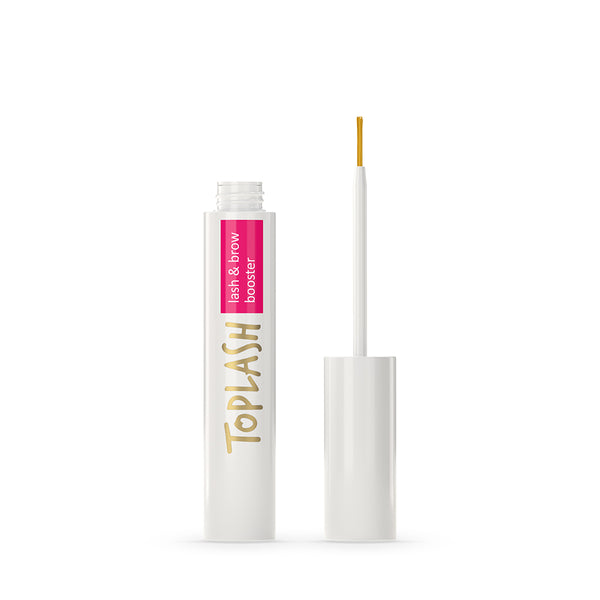
Toplash Lash & Brow Serum
The complete AT-3 + BTP-1 + MP-17 growth-peptide system with independent clinical data: +52.3% length and +31.9% volume at 8 weeks. Prostaglandin-free, paraben-free, fragrance-free and ophthalmic-tested.
Shop Toplash SerumFrequently Asked Questions
What is a peptide lash serum?
A peptide lash serum is a cosmetic product that uses short amino acid chains (peptides) as active ingredients to stimulate eyelash growth at the follicle level. Key peptides include MP-17 (upregulates keratin gene expression), BTP-1 (strengthens follicle anchoring) and AT-3 (prevents follicle miniaturisation). Unlike prostaglandin serums, peptide serums work through growth factor signalling pathways rather than hormonal FP receptor agonism.
How do peptides grow eyelashes?
Through three mechanisms: (1) MP-17 stimulates keratin genes (KRT3, KRT19) → more structural protein → thicker, stronger fibres; (2) BTP-1 supports laminin and collagen synthesis → stronger follicle anchoring → less premature shedding; (3) AT-3 maintains dermal papilla size → sustained follicle health → consistent density.
How long do peptide lash serums take to show results?
Visible changes typically begin at Week 3–4. Maximum results at 8–12 weeks. In Toplash's independent trial, 98% of participants saw a visible change by Day 21, with +52.3% length and +31.9% volume at 8 weeks.
Are peptide lash serums safe?
Peptide serums without prostaglandins, fragrance, BAK, alcohol or parabens have an excellent safety profile. They work through growth factor signalling at the follicle level — not through hormonal pathways — so there is no mechanism for iris colour change, periorbital fat atrophy, or systemic effects. The 2026 SCCS Opinion SCCS/1680/25 confirmed safety concerns about PGAs; peptide actives were not flagged.
What is the difference between a peptide lash serum and a prostaglandin serum?
Prostaglandin serums bind FP receptors and extend the anagen phase through a hormonal pathway — same mechanism as bimatoprost glaucoma drops. Strong results, but documented risks (iris darkening, fat atrophy, eyelid darkening). Peptide serums work through KGF receptor signalling — non-hormonal, follicle-local, with no documented systemic ocular effects. The 2026 SCCS confirmed PGAs are unsafe in cosmetics; peptides are not under any regulatory concern.
What results can I expect from a peptide lash serum?
With consistent daily use: visible conditioning from Week 1–2; noticeable length and density from Week 4–6; maximum results at 8–12 weeks. Toplash clinical data: +52.3% lash length, +31.9% volume at 8 weeks, 98% of participants with visible change by Day 21. Results maintained with ongoing use; gradual return to natural baseline over 2–4 months if discontinued.
What should I look for in a peptide lash serum?
Named peptide actives on the INCI list (MP-17, BTP-1, AT-3); no prostaglandin analogs; independent clinical trial evidence; formula free of fragrance, BAK, alcohol and parabens; transparent full INCI labelling. Avoid products with vague "growth factor complex" claims without specific ingredient disclosure.
References
- Adoreyes. "How Does Peptide Eyelash Growth Serum Work? The science, explained!" Blog. 2024.
- Valencia Cosmetica. "The Science Behind Peptide-Based Lash Growth Serums." 2025.
- Toplash Cosmetics. Internal clinical trial data, 8-week independent study. 2025.
- Elias PM, et al. "An Open-label, Single-center, Safety and Efficacy Study of Eyelash Polygrowth Factor Serum." J Clin Aesthet Dermatol. 2020. PMC7158911. View Study
- Scientific Committee on Consumer Safety. Opinion SCCS/1680/25 on ICP, DDDE and MDN in cosmetic products. European Commission; 2 February 2026. View PDF
- The Lash List. "Do Lash Serums Really Work? The Science-Backed Answer (2026)." 2026.
- Pro Lash. "Lash Growth Serums — Peptides and Prostaglandins." Blog. 2024.
- Peptidepedia. "Best Peptides for Hair Growth: Ranked by Evidence (2026)." 2026.