
The Eyelash Growth Cycle: Anagen, Catagen & Telogen Explained
Every result timeline, every serum mechanism, every shedding pattern — all trace back to the three phases of the lash growth cycle. Here is the complete science.
Updated: June 20, 2026 Written by: Branda M. Heim Reviewed by: Branda M. Heim, Board-Certified Cosmetologist9 referencesView Toplash SerumThe eyelash growth cycle has three phases: Anagen (4–10 weeks active growth, ~38% of lashes at any time), Catagen (2–3 weeks transition, ~10%) and Telogen (3–4 months resting/shedding, ~52%). The complete cycle takes 4–11 months. Lash growth serums work by extending the anagen phase — more weeks of growth per follicle means longer lashes at maximum length. The 8–12 week result timeline for serums directly reflects biological cycle timing.
The Three Phases: An Overview
Understanding each phase is essential for interpreting lash serum results, setting correct timeline expectations, and distinguishing normal shedding from a genuine problem. Each lash follicle cycles independently and asynchronously from its neighbours — which is why you never lose all your lashes at once and always maintain a visible set.
Phase 1: Anagen — The Active Growth Phase
Anagen is the phase in which the lash actively grows from the follicle. During anagen, the hair matrix cells at the base of the follicle divide rapidly, pushing the hair shaft upward through the follicle canal and out through the skin.
What is happening biologically:
- The dermal papilla (a cluster of specialised mesenchymal cells at the base of the follicle) receives blood supply and provides growth signals to the hair matrix
- Matrix cells — the fastest-dividing cells in the body — produce keratin, the structural protein that forms the lash shaft
- Keratinocyte growth factor (KGF) and insulin-like growth factor-1 (IGF-1) are the primary signalling molecules that maintain anagen duration
- The longer anagen lasts, the greater the final lash length — because the lash keeps growing throughout this phase
Why eyelash anagen is much shorter than scalp hair anagen: Scalp hair anagen lasts 2–7 years, which is why head hair grows long. Eyelash anagen is only 4–10 weeks, which limits the maximum length a lash can reach without intervention. This is entirely genetic — determined by the sensitivity of dermal papilla cells to growth signals and the timing of catagen-initiating signals.
Phase 2: Catagen — The Transition Phase
Catagen is a brief but critical transition phase that signals the end of active growth. It is triggered by apoptosis (programmed cell death) in the hair matrix and dermal papilla. Once catagen begins, growth stops completely.
What is happening biologically:
- The lower portion of the follicle undergoes controlled regression — the follicle shaft shrinks upward by approximately 70%
- The connection between the follicle and its blood supply (the dermal papilla) is severed — the lash is now a "club hair" with no active nourishment
- The lash itself maintains its length gained during anagen — it does not shorten or thin during catagen
- The dermal papilla migrates upward to rest beneath the follicle bulge, awaiting the next anagen signal
Because the lash maintains its length but stops growing in catagen, this phase is essentially a "holding period." The lash looks and feels completely normal — this phase is invisible to the naked eye.
Phase 3: Telogen — The Resting & Shedding Phase
Telogen is the longest phase of the lash cycle, accounting for the majority of lash life at any given moment. The old "club hair" sits anchored in the follicle while a new anagen lash begins to form beneath it.
What is happening biologically:
- The resting club hair is loosely anchored in the follicle. Light pulling (from rubbing, makeup removal or simply touching) can release it — this is normal natural shedding, not damage
- Beneath the resting lash, the dermal papilla reactivates and begins the next anagen cycle — a new lash grows upward, eventually pushing the old lash out
- The "exogen" sub-phase refers specifically to the active shedding moment when the old hair is released. Some researchers classify this as a fourth phase
- Daily natural lash shedding of 1–5 lashes is entirely normal — you are always shedding telogen lashes while new anagen lashes grow beneath
Why ~52% of lashes are in telogen at any time: The telogen phase (3–4 months) is proportionally much longer than anagen (4–10 weeks) or catagen (2–3 weeks). So across the full population of ~150 upper lashes, the majority are always resting. This is why it can appear that a lash serum only affects a fraction of visible lashes at first — it can only extend anagen for the 38% currently in that phase.
Your Lash Population Right Now
At this precise moment, your approximately 150–200 upper lashes are distributed across the three phases like this:
Because ~52% of your lashes are always in telogen, regular shedding of 1–5 lashes per day is entirely normal. Finding a lash on your pillow or makeup brush does not mean your lash serum stopped working — it means a telogen lash reached its natural shedding point.
How Lash Serums Work Within the Growth Cycle
All lash growth serums share one core mechanism: extending the anagen phase. A longer anagen means more weeks of active growth, which means greater final lash length before catagen terminates growth. This is the only way a topical product can produce genuine lash growth — by manipulating cycle timing, not by externally adding length to hairs.
How Anagen Extension Produces Longer Lashes
A follicle normally has an anagen phase of, for example, 6 weeks — growing at 0.13 mm/day = 5.5 mm maximum lash length. If a serum extends anagen to 9 weeks, the same follicle reaches 8.2 mm — a 49% length increase, driven purely by cycle extension.
This is the biology behind Toplash's +52.3% length increase at 8 weeks — it reflects extended anagen duration across multiple follicle cohorts, measured after two full treatment cycles.
Why Results Take 8–12 Weeks: A Biological Explanation
When you start applying a lash serum, only the ~38% of lashes currently in anagen can respond to the growth signal. The other ~62% (in catagen or telogen) are not in an active growth phase and cannot be directly influenced until they begin their next anagen cycle.
This means initial results appear in one follicle cohort (Day 21–Week 6), with additional cohorts entering extended anagen as they transition from telogen over subsequent weeks. By Week 8–12, multiple cohorts have completed extended anagen cycles and the cumulative population-level density and length increase becomes clearly visible.
Complete Lash Cycle Reference Table
| Parameter | Anagen | Catagen | Telogen |
|---|---|---|---|
| Duration | 4–10 weeks | 2–3 weeks | 3–4 months |
| Percentage of lashes (upper) | ~35–40% | ~10% | ~50–55% |
| Percentage of lashes (lower) | ~15% | ~5% | ~80% |
| Lash growth rate | 0.12–0.14 mm/day | 0 mm/day | 0 mm/day (old); 0.12+ (new forming beneath) |
| Blood supply connection | Yes — active vascularisation | No — detached during catagen | No (old lash); Yes (new forming) |
| Key biological signals | KGF, IGF-1, VEGF, Wnt signalling | FGF5, TGF-β1 (catagen-initiating) | BMP signalling; dermal papilla reactivation |
| Lash serum effect | Extends duration — directly responsive to growth signals | Cannot be extended — catagen already initiated | Cannot be reversed — must wait for next anagen |
| Visible change if lash lost | Noticeable gap — anagen lash at near-full length | Minimal — at full length, loosely anchored | Minimal — telogen lash shorter than anagen lash |
How Age Affects the Lash Growth Cycle
Age-Related Changes to the Lash Cycle
- Shorter anagen duration: Declining IGF-1 and KGF signalling with age reduces the duration of the anagen phase, producing progressively shorter maximum lash length
- Follicle miniaturisation: Dermal papilla cells decrease in number and activity over time (a process called follicle miniaturisation), producing progressively thinner, shorter lashes — analogous to androgenic alopecia in scalp hair
- Reduced vascularisation: Blood supply to periorbital tissue decreases with age, reducing nutrient delivery to the dermal papilla during anagen
- Hormonal shifts: Menopause-related oestrogen decline further shortens anagen — estrogenic signalling supports anagen maintenance. Postmenopausal women commonly report lash thinning for this reason
- Increased telogen fraction: The proportion of lashes in telogen increases with age, meaning fewer lashes are actively growing at any one time
Acetyl Tetrapeptide-3 (AT-3) — one of Toplash's three active peptides — specifically targets the dermal papilla maintenance pathway, counteracting the cell-density decline that drives age-related follicle miniaturisation. This makes peptide serums particularly relevant for users experiencing age-related lash changes.
"What most people don't realise is that a lash serum cannot make every lash longer simultaneously. It can only act on the cohort currently in anagen — which is never more than 40% of lashes at once. That's why results emerge gradually over 8–12 weeks as successive cohorts cycle into an extended anagen influenced by the serum. Understanding this biology turns impatience into an informed wait."
Normal Shedding vs. Cause for Concern
| Pattern | Normal or Concerning? | Explanation |
|---|---|---|
| 1–5 lashes shed per day | ✓ Normal | Telogen lashes naturally shed daily as new anagen lashes form beneath them |
| Lash found on pillow or cheek | ✓ Normal | Telogen lashes are loosely anchored and shed with minimal friction |
| More shedding than usual for 1–2 weeks | ✓ Often Normal | Telogen effluvium response to a stressor 8–12 weeks prior (illness, surgery, stress) |
| Sudden heavy shedding, >10/day | ⚠ Investigate | May indicate thyroid disorder, iron deficiency, medication side effect or telogen effluvium |
| Patchy lash loss — specific areas missing | ⚠ See a doctor | May indicate alopecia areata (autoimmune) or madarosis — requires dermatological evaluation |
| Lashes not regrowing after 16+ weeks | ⚠ See a doctor | May indicate follicle damage (from traction, chemotherapy) or systemic cause |
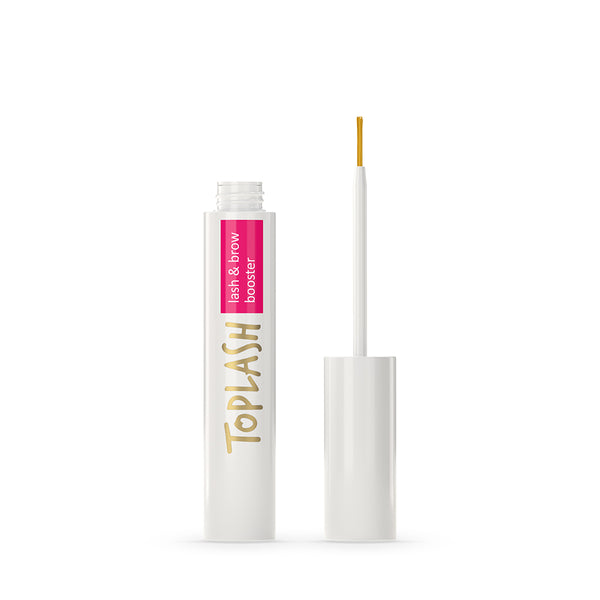
Toplash Lash & Brow Serum
The complete AT-3 + BTP-1 + MP-17 growth-peptide system with independent clinical data: +52.3% length and +31.9% volume at 8 weeks. Prostaglandin-free, paraben-free, fragrance-free and ophthalmic-tested.
Shop Toplash SerumFrequently Asked Questions
How long is the eyelash growth cycle?
The complete eyelash growth cycle takes approximately 4–11 months: anagen (active growth) lasts 4–10 weeks, catagen (transition) lasts 2–3 weeks, and telogen (resting and shedding) lasts 3–4 months. Each follicle cycles independently and asynchronously — which is why you don't lose all your lashes at once and always maintain a visible set.
How long does it take eyelashes to grow back after falling out?
After a lash naturally sheds, the follicle enters a brief resting period before beginning a new anagen cycle. Full regrowth from bare follicle to full-length lash takes approximately 6–16 weeks, depending on the individual's anagen phase duration. If a lash is broken rather than shed (retaining the root), regrowth from that point may be faster. If regrowth is significantly slower than this timeline, an underlying health factor such as thyroid dysfunction or iron deficiency may be involved.
Why do my eyelashes fall out randomly?
Random natural lash shedding is completely normal. At any moment, about 52% of your upper lashes are in telogen (resting phase) — loosely anchored and ready to shed. Shedding 1–5 lashes per day is within the normal range. If shedding is sudden, patchy or significantly heavier than usual, consult a dermatologist or GP to rule out thyroid dysfunction, iron deficiency or alopecia areata.
How do lash serums affect the growth cycle?
Lash serums with active growth ingredients extend the anagen (active growth) phase. PGA serums (ICP, DDDE, bimatoprost) do this via FP-receptor agonism in the dermal papilla. Peptide serums like Toplash do this via KGF receptor signalling, which prolongs anagen by maintaining dermal papilla cell activity and upregulating keratin gene expression. A longer anagen phase means each lash grows for more weeks before catagen terminates growth — producing greater final length.
Why do lash serums take 8–12 weeks to work?
Because the lash anagen phase lasts 4–10 weeks, and a serum can only act on the ~38% of follicles currently in anagen. The first cohort of extended-anagen lashes becomes visible around Day 21–Week 6; as additional follicle cohorts transition from telogen into anagen over subsequent weeks, they also enter extended cycles — producing the full population-level density and length improvement visible at 8–12 weeks. This timeline is biological and cannot be compressed by applying more product.
What percentage of my lashes are growing at any one time?
Approximately 35–40% of upper eyelash follicles are in anagen (active growth) at any given time, about 10% are in catagen (transition), and the remaining 50–55% are in telogen (resting or shedding). Lower lash follicles have a shorter anagen phase — only about 15% are actively growing at once. This distribution means lash density remains relatively constant despite continuous natural shedding.
Does age affect the lash growth cycle?
Yes. With age, anagen duration shortens, follicles undergo miniaturisation (producing thinner, shorter lashes), and the proportion of follicles in telogen increases. Hormonal changes during menopause — particularly declining oestrogen — further shorten anagen. Age-related lash thinning is common and primarily reflects cycle changes rather than follicle loss. Peptide serums targeting the dermal papilla maintenance pathway (via AT-3/Acetyl Tetrapeptide-3) specifically counteract follicle miniaturisation.