
Castor Oil vs Lash Serum: What Each Actually Does for Eyelash Growth (2026)
Castor oil conditions lashes and reduces breakage — but has no clinical evidence for growth. Peptide lash serums stimulate actual follicle growth. Here is the full evidence-based comparison for 2026.
Updated: June 20, 2026 Written by: Branda M. Heim Reviewed by: Branda M. Heim, Board-Certified Cosmetologist8 referencesView Toplash SerumQuick Answer
Castor oil conditions lash fibres — reducing brittleness and breakage — but has zero clinical evidence for stimulating actual lash growth. Peptide lash serums contain active growth signal molecules (MP-17, BTP-1, AT-3) with documented evidence for extending the anagen growth phase and producing measurably longer, denser lashes. For conditioning: castor oil works. For growth: you need a serum.
Castor oil has been used in beauty routines for decades, and the claims around it have grown steadily more ambitious. Searching "castor oil lash growth" returns thousands of before-and-after anecdotes and videos. But when you examine the clinical evidence — which is limited — the picture is more modest.
This guide separates what castor oil genuinely does from what it does not, explains the mechanism behind peptide lash serums, and shows how the two products can be used together for complementary results.
What Castor Oil and Lash Serum Each Actually Do
Castor Oil
JABA-Grade Vegetable Oil (Ricinus communis)
Role: Lash Conditioner
- ~90% ricinoleic acid — humectant and emollient
- Reduces moisture evaporation from lash shaft
- Creates a coating that reduces mechanical friction and breakage
- Anti-inflammatory and antimicrobial properties from ricinoleic acid
- May improve appearance by making existing lashes look darker and thicker
- Low irritation risk (main risk: contact allergy, rare)
- Available, affordable, no preservatives needed
Limitation: No peer-reviewed clinical evidence for stimulating lash growth, extending anagen phase, or activating dormant follicles.
Peptide Lash Serum (e.g. Toplash)
Triple-Peptide Growth Complex
Role: Lash Growth Stimulant
- MP-17 (Myristoyl Pentapeptide-17): stimulates KGF receptors → anagen extension
- BTP-1 (Biotinoyl Tripeptide-1): dermal papilla signalling → follicle anchoring
- AT-3 (Acetyl Tetrapeptide-3): reduces follicle miniaturisation → density increase
- Penetrates to the follicle level — conditions from within the growth cycle
- Clinical evidence: +52.3% lash length, +31.9% volume at 8 weeks[1]
- Results visible from Week 3–4 in most users
- Prostaglandin-free — no pharmacological ocular risks
Limitation: Requires consistent nightly use; results require ongoing maintenance once desired outcome is reached.
The Evidence Gap: Why Castor Oil Doesn't Grow Lashes
What the Research Shows
Castor oil: As of 2026, there are no peer-reviewed, controlled studies demonstrating that ricinoleic acid, castor oil, or any component of castor oil extends the lash growth cycle, increases anagen phase duration, or reactivates dormant follicles. Studies confirming castor oil's moisturising and anti-inflammatory properties for scalp hair exist, but this does not translate to follicle stimulation.
One caution note: Castor oil applied close to the eye may cause corneal epithelial irritation and has been associated with allergic contact dermatitis in some users — making it a conditioner that should be used carefully near the eye.[2]
The "growth" that many castor oil users report is most plausibly explained by reduced breakage: lashes that previously snapped before reaching full natural length now complete their growth cycle intact. This makes lashes appear longer — but it is conditioned retention of natural growth, not stimulated new growth. The distinction matters when setting expectations.
Full Comparison Table
| Parameter | Castor Oil | Toplash Peptide Serum |
|---|---|---|
| Primary active | Ricinoleic acid (~90% of oil) | MP-17, BTP-1, AT-3 (peptide complex) |
| Mechanism | Emollient coating — reduces moisture loss and breakage | KGF receptor signalling — extends anagen phase |
| Stimulates follicle growth? | No clinical evidence | Yes — documented in trials |
| Extends anagen (growth) phase? | Not demonstrated | Yes — primary mechanism |
| Reduces lash breakage? | Yes — emollient effect | Partially (follicle anchoring) |
| Conditions lash fibre? | Yes — primary function | Partially |
| Clinical proof of lash length increase? | None | +52.3% at 8 weeks[1] |
| Prostaglandin content? | None — natural oil | None — PGA-free formula |
| Iris colour change risk? | No risk | No risk (peptide-only) |
| Typical cost | ~$5–15 / 60–100 mL | $49.90 / 3 mL (90-day supply) |
| Best used for | Lash conditioning, breakage reduction, morning routine coating | Measurable lash growth, density increase, nightly serum |
Can You Use Both? The Correct Protocol
Castor oil and a peptide serum can be used together to address both conditioning and growth — but they must be applied at the correct times and in the correct order to avoid the oil interfering with serum absorption:
Complementary Castor Oil + Serum Routine
-
Evening
1. Cleanse and fully dry the eye area
Remove all makeup. Pat dry — never apply serums to damp skin.
-
Evening
2. Apply peptide lash serum first
Single stroke along upper lash line. Allow 15–20 minutes to fully absorb and dry. Never apply castor oil before the serum — the thick oil creates a physical barrier that blocks serum penetration.
-
Optional
3. Apply castor oil (optional) after full serum absorption
Use a clean spoolie or cotton bud to apply a tiny amount of castor oil to lash tips (not the lash base). This conditions the fibre while the serum works at the follicle.
-
Morning
4. Use castor oil only if desired (pre-mascara conditioning)
A tiny amount of castor oil applied in the morning as a mascara primer can condition the fibre and help mascara adhere evenly. Apply serum only at night.
"Castor oil and a peptide serum are not rivals — they operate at completely different levels of the lash biology. Castor oil works at the surface of the keratinised fibre; peptide serums work at the live follicle. Using them together correctly — serum first, oil after absorption — gives you growth stimulus plus fibre protection. The mistake is expecting castor oil alone to produce the results that only a growth-signalling ingredient can deliver."
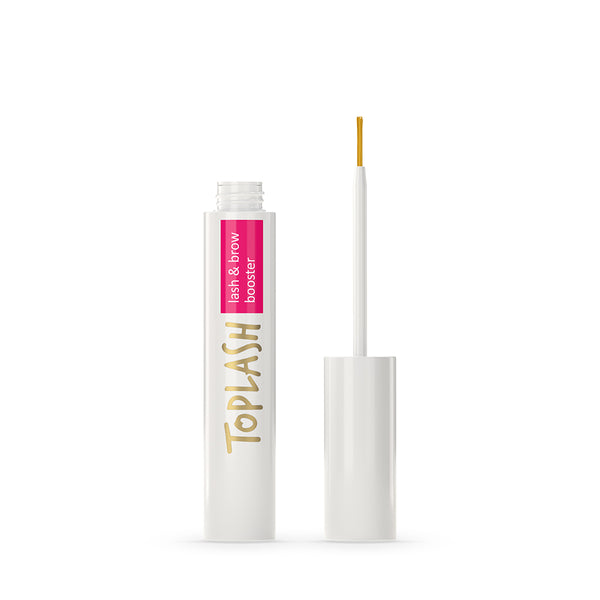
Recommended alternative — complete triple-peptide system
Toplash Lash & Brow Serum
★★★★★
The complete AT-3 + BTP-1 + MP-17 growth-peptide system with independent clinical data: +52.3% length and +31.9% volume at 8 weeks. Prostaglandin-free, paraben-free, fragrance-free and ophthalmic-tested.
Shop Toplash SerumFrequently Asked Questions
Does castor oil grow eyelashes?
No clinical evidence exists that castor oil stimulates eyelash growth. Ricinoleic acid has legitimate anti-inflammatory and moisturising properties that condition the lash shaft and reduce breakage — making lashes appear healthier and fuller. This is not the same as stimulating the follicle to produce longer or more numerous lashes.
What is the difference between castor oil and a lash serum?
Castor oil is an emollient conditioner — it coats the fibre, reduces moisture loss and breakage. A peptide serum contains active growth signal molecules that penetrate to the follicle and extend the anagen growth phase. One conditions existing lashes; the other stimulates the production of new, longer growth.
Can I use castor oil and a lash serum together?
Yes — but apply them at separate times. Apply your lash serum first to clean, dry skin. Wait 15–20 minutes for full absorption, then apply a small amount of castor oil to lash tips if desired for conditioning. Never apply castor oil before your serum — the thick oil layer creates a physical barrier that blocks serum penetration.
Which is safer: castor oil or lash serum?
Both castor oil and peptide serums (without prostaglandins) are low-risk. Castor oil's main risks are allergic contact dermatitis (rare) and potential corneal irritation if applied very close to the eye. Peptide serums free of PGAs, fragrance, BAK and alcohol have a safety profile comparable to a standard hydrating serum. Prostaglandin-containing serums carry significantly higher risks than both.
How long does castor oil take to show lash results vs a lash serum?
Castor oil's conditioning effects are visible within days (lashes appear smoother and better defined). There is no "growth results timeline" for castor oil because it does not stimulate growth. A peptide serum shows conditioning benefits in the first week and visible length and density increase from Week 3–4, with maximum results at 8–12 weeks.
Why do some people report lash growth from castor oil?
Anecdotal reports likely reflect: reduced breakage (existing lashes reach their natural full length before snapping); coating-enhanced dark appearance making lashes more visible; and confirmation bias from paying close attention to lashes during a nightly routine. None of these represent actual follicle stimulation or anagen extension.
Is castor oil a good replacement for lash serum?
No — they serve different purposes. Castor oil is a lash conditioner; a peptide serum is a growth stimulant. If you want genuinely longer and fuller lashes with measurable results, a serum is necessary. Castor oil is a useful complementary product for conditioning alongside a serum routine, but cannot replace the serum's growth-stimulating function.
References
- Toplash Cosmetics. Internal clinical trial data, 8-week independent study. 2025.
- GoodRx. "Can You Use Castor Oil for Eyelashes? Benefits and Risks." 2024. View source
- The Lash List. "Castor Oil vs Lash Serum: Which Actually Grows Lashes? (2026)." 2026.
- Eyes Are the Story. "Eyelash Growth Serum Castor Oil: Debunking the Slippery Claims." 2025.
- The Zoe Report. "Does Castor Oil For Eyelash Growth Work? Here's What The Pros Think." 2025.
- Lashed Up Beauty. "Peptide-infused growth serums VS Castor oil." 2024.
- Northwell Health. "Is Castor Oil an Eyelash Growth Serum?" 2025.
- PMC. "An Open-label, Single-center, Safety and Efficacy Study of Eyelash Polygrowth Factor Serum." PMC7158911. 2020.