
RevitaLash Advanced vs Latisse:Which Is Worth It in 2026?
Latisse wins on clinical evidence — FDA-approved, RCT-backed, the gold standard for lash growth treatment. But it requires a prescription and uses drug-grade bimatoprost with documented side effects. RevitaLash Advanced is OTC but contains DDDE — a prostaglandin analogue the EU SCCS ruled "cannot be considered safe" in February 2026 — and faces a class action lawsuit over undisclosed side effects. RevitaLash explicitly reformulated from bimatoprost to DDDE in 2007 to avoid FDA restrictions, yet the 2026 EU ruling confirms DDDE carries the same class concerns. For a prescription-free, prostaglandin-free option with independent clinical data, Toplash delivers +52.3% lash length in 8 weeks.
Updated: June 20, 2026 Written by: Branda M. Heim Reviewed by: Branda M. Heim, Board-Certified CosmetologistView Toplash SerumLatisse wins on clinical evidence — FDA-approved, RCT-backed, the gold standard for lash growth treatment. But it requires a prescription and uses drug-grade bimatoprost with documented side effects. RevitaLash Advanced is OTC but contains DDDE — a prostaglandin analogue the EU SCCS ruled "cannot be considered safe" in February 2026 — and faces a class action lawsuit over undisclosed side effects. RevitaLash explicitly reformulated from bimatoprost to DDDE in 2007 to avoid FDA restrictions, yet the 2026 EU ruling confirms DDDE carries the same class concerns. For a prescription-free, prostaglandin-free option with independent clinical data, Toplash delivers +52.3% lash length in 8 weeks.
Three-Way At a Glance
Revitalash Inc.
RevitaLash Advanced
- Rx required? ✓ No (OTC)
- Active PGA DDDE (EU flagged)
- EU SCCS safe? ✗ DDDE not safe
- Clinical evidence Ophth. supervised
- Class action? ⚠ Yes (undisclosed)
- Price / mL ~$33–$35/mL
Allergan / AbbVie
Latisse (bimatoprost 0.03%)
- Rx required? ✗ Prescription only
- Active PGA Bimatoprost (Rx drug)
- FDA status ✓ Approved (Rx)
- Clinical evidence ✓ Multiple RCTs
- Class action? No
- Price / mL ~$56/mL (brand)
✓ Best OTC Option
Toplash Cosmetics
Lash & Brow Serum
- Rx required? ✓ No (OTC)
- Active Triple peptide (no PGA)
- EU SCCS safe? ✓ Compliant
- Clinical evidence ✓ Independent trial
- Class action? No
- Price / mL $16.63/mL
RevitaLash vs Latisse: Head-to-Head
A factor-by-factor breakdown of the two products most frequently compared by users considering a shift from OTC to Rx — or vice versa.
| Factor | RevitaLash Advanced | Latisse (bimatoprost) |
|---|---|---|
| Requires prescription? | ✓ No — OTC | ✗ Prescription required |
| Regulatory approval | Cosmetic | ✓ FDA-approved Rx drug |
| Active prostaglandin | DDDE (OTC cosmetic) | Bimatoprost 0.03% (Rx drug) |
| EU SCCS compliant | ✗ DDDE not safe | ⚠ Drug (not cosmetic-evaluated) |
| Clinical evidence type | Ophthalmologist supervised | ✓ Multiple RCTs |
| Results timeline | 8–12 wks visible | 4–8 wks visible; 16 wks full |
| Iris color change risk | ✗ DDDE risk | ⚠ Rare, can be permanent |
| Periorbital fat loss risk | ✗ DDDE risk | ⚠ Reported long-term |
| Dry eye / blepharitis risk | ✗ DDDE associated | ⚠ Conjunctival redness |
| Class action lawsuit? | ✗ Filed (undisclosed SE) | No |
| FDA enforcement history | ⚠ Prior action (2007 reformulation) | ✓ Approved; monitored |
| Rebound on discontinuation | ✗ PGA rebound | ✗ Returns to baseline |
| Standard price / mL | ~$33–$35/mL | ~$56/mL brand; ~$10–15 generic |
DDDE vs Bimatoprost: The Key Molecule Difference
RevitaLash's 2007 reformulation from bimatoprost to DDDE was a regulatory strategy — not a safety upgrade. The EU SCCS 2026 ruling confirms both molecules belong to the same risk category.
RevitaLash Advanced
DDDE + BioPeptin Complex
- DDDE (Dechloro Dihydroxy Difluoro Ethylcloprostenolamide) ⚠ EU: Not Safe — prostaglandin analogue at 0.018%. Replaced bimatoprost in 2007. EU SCCS ruled it unsafe (Feb 2026). Associated with blepharitis, meibomian gland dysfunction, and chronic dry eye in addition to iris color change risk.
- BioPeptin Complex — proprietary peptide blend including sh-Oligopeptide-1; conditioning and follicle-support alongside DDDE.
- Green tea extract (EGCG) — antioxidant; free radical protection at the follicle zone.
- Biotin, Panthenol — keratin and fibre conditioning agents.
Latisse (bimatoprost 0.03%)
Bimatoprost — Drug-Grade Prostamide
- Bimatoprost 0.03% Rx Drug — FDA-approved prostamide. Higher potency than DDDE. Originally a glaucoma medication. Produces significant, RCT-verified lash growth but carries drug-level side effects and requires physician prescription.
- Benzalkonium chloride — preservative; can cause ocular irritation in sensitive users.
- Sodium phosphate, citric acid — pH buffers designed for ocular-safe application.
Safety: Shared PGA Risks
Despite being chemically different, DDDE and bimatoprost share the same risk profile because they both activate prostaglandin receptors in the hair follicle and ocular tissue.
The EU SCCS evaluated DDDE (RevitaLash) specifically and concluded it "cannot be considered safe for use in cosmetic products intended for application in the vicinity of the eye." The same opinion evaluated bimatoprost (Latisse) and the related class of prostaglandin analogues with the same conclusion.
Verdict
🏥 Rx Winner: Latisse · 🏆 Safe OTC Winner: Toplash
Both Have PGAs — The Right Answer Depends on Your Situation
Under physician supervision for a clinical lash loss diagnosis: Latisse has the strongest evidence base of any lash treatment. For OTC cosmetic users: RevitaLash is not a safe choice in 2026 — its DDDE is EU-flagged, it faces a class action lawsuit, and it costs ~$33–35/mL. Both products require ongoing use to maintain results, and both carry prostaglandin-associated side effects.
Toplash is the answer for anyone who wants OTC lash enhancement without a prescription, without prostaglandin risks, and with independently verified results: +52.3% lash length in 8 weeks, EU SCCS compliant, at $16.63/mL.
Try Toplash OTC — $49.90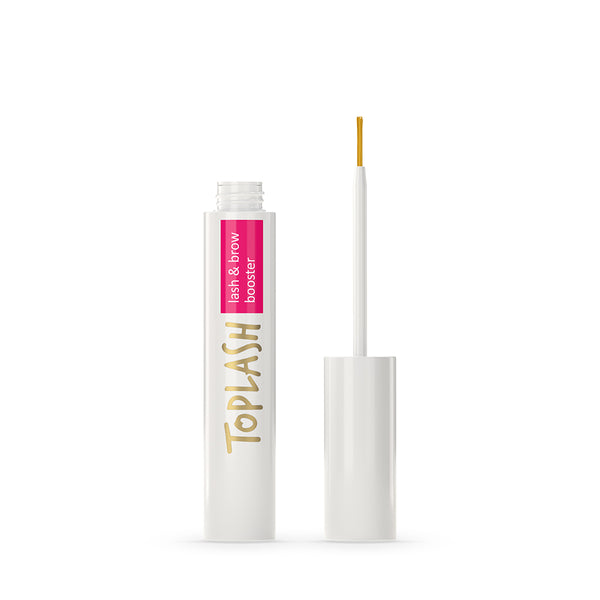
Recommended — prostaglandin-free triple-peptide
Toplash Lash & Brow Serum
MP-17 + BTP-1 + AT-3 with independent clinical data: +52.3% length and +31.9% volume at 8 weeks. Prostaglandin-free, paraben-free, ophthalmic-tested and extension-safe.
Shop Toplash SerumFrequently Asked Questions
Is RevitaLash as effective as Latisse?
Latisse is more clinically proven — it's the only FDA-approved Rx treatment for eyelash hypotrichosis, with multiple randomized controlled trials. RevitaLash Advanced uses DDDE (a weaker PGA than bimatoprost) and is supported by ophthalmologist-supervised studies rather than independent RCTs. Both are effective, but Latisse has stronger evidence. For independent clinical data without a prescription or PGA risk, Toplash shows +52.3% lash length in 8 weeks in an independent clinical trial.
Does RevitaLash contain prostaglandins?
Yes. RevitaLash Advanced contains DDDE (dechloro dihydroxy difluoro ethylcloprostenolamide) at 0.018% — a synthetic prostaglandin analogue. RevitaLash reformulated from bimatoprost to DDDE in 2007 following FDA enforcement action. The EU SCCS evaluated DDDE in SCCS/1680/25 (February 2026) and concluded it "cannot be considered safe" for cosmetic use near the eyes.
What happened with the RevitaLash class action lawsuit?
A class action lawsuit was filed against RevitaLash alleging undisclosed side effects including iris color change, blepharitis, meibomian gland dysfunction, and chronic dry eye. The lawsuit claims consumers were not adequately warned about these risks. This follows RevitaLash's earlier 2007 FDA enforcement history, which triggered the switch from bimatoprost to DDDE. The 2026 EU SCCS ruling confirms DDDE itself shares similar safety concerns to its predecessor active.
Is RevitaLash or Latisse better for sensitive eyes?
Neither product is appropriate for highly sensitive eyes due to their prostaglandin analogue content. Latisse can cause conjunctival redness, periorbital darkening, and rare iris color change. RevitaLash's DDDE has been associated with blepharitis, meibomian gland dysfunction, and dry eye in addition to iris change risk. For sensitive eyes, Toplash — a prostaglandin-free, ophthalmologist-tested triple-peptide serum — is significantly safer for both short and long-term use.
Can I switch from RevitaLash to Latisse?
Switching from RevitaLash to Latisse substitutes one prostaglandin analogue for another — it doesn't reduce PGA exposure. Latisse requires a doctor's prescription and costs significantly more. If you want to reduce prostaglandin risk, the better move is switching to a PGA-free serum like Toplash and allowing your lash cycle to reset from PGA dependency while supporting follicle health with its peptide complex.
What is a safer OTC alternative to both RevitaLash and Latisse?
Toplash is the strongest prostaglandin-free OTC alternative. Its triple-peptide complex (MP-17, BTP-1, AT-3) delivers independently verified +52.3% lash length and +31.9% volume in 8 weeks — no prescription, no prostaglandin analogue, EU SCCS compliant. At $49.90/3mL ($16.63/mL), it costs significantly less than RevitaLash (~$33–35/mL) and brand-name Latisse (~$56/mL) per milliliter.
Is Latisse safe for long-term use?
Latisse is FDA-approved and generally well tolerated under physician supervision. Its documented side effects include periorbital skin darkening (usually reversible), conjunctival redness, and rare but potentially permanent iris color change in susceptible individuals, especially those with green or hazel eyes. Orbital fat atrophy has been reported with long-term use. Latisse requires ongoing application — lashes return to baseline when discontinued. It is a Rx drug and should only be used under medical oversight.