
Can Lash Serum Change Your Eye Color? The Science Behind Iris Darkening (2026)
Can a lash serum permanently change your eye colour? Only prostaglandin serums carry this risk — through iris melanin stimulation. Peptide serums cannot. Full mechanism, risk data and 2026 SCCS ruling explained.
Updated: June 20, 2026 Written by: Branda M. Heim Reviewed by: Branda M. Heim, Board-Certified Cosmetologist10 referencesView Toplash SerumYes, but only prostaglandin-containing serums carry this risk. Prostaglandin analogs (ICP, DDDE, bimatoprost) stimulate iris melanocytes to produce more melanin, potentially darkening the iris permanently in susceptible eyes. Peptide serums have no melanocyte-stimulating mechanism — they cannot change eye colour. If you notice a colour shift, stop immediately and see an ophthalmologist.
Eye colour change from a lash serum is not a cosmetic marketing claim — it is a documented pharmacological side effect of a specific class of ingredients. The first reports came from glaucoma patients treated with bimatoprost eye drops in the 1990s, who noticed their irises darkening over months of daily use. As prostaglandin analogs migrated into cosmetic lash serums, the same mechanism followed.
Understanding why this happens, who is most at risk, and which serums are safe is essential knowledge for anyone using a lash growth product.
How Prostaglandin Serums Change Iris Colour
The mechanism is well-characterised in the ophthalmology literature. Prostaglandin analogs bind to FP (prostanoid) receptors located on iris melanocytes — the pigment-producing cells in the iris stroma. This binding triggers a cascade that increases melanogenesis: the production of melanin granules within the existing cell population.
-
PGA migrates from lash line to eye: Prostaglandin analog applied to the upper lash line migrates via blinking, tearing, and capillary action into the conjunctival sac and anterior chamber. The migration volume is small but pharmacologically active.
-
PGA binds to FP receptors on iris melanocytes: Iris melanocytes express prostaglandin FP receptors. Chronic exposure to migrated PGA leads to receptor activation, triggering intracellular cAMP and PKC signalling cascades that up-regulate melanogenesis.[1]
-
Melanin production increases without new cells: Critically, the increase in melanin is due to more melanin granules within existing melanocytes — not proliferation of new cells, not inflammation, and not a pre-cancerous change. This distinguishes it from pathological pigment changes.
-
Brown pigmentation spreads from around the pupil outward: Typically manifests as increased brown pigmentation starting in the periciliary zone (around the pupil border) and spreading concentrically toward the limbus over months to years. Most visible in hazel, green, or blue-brown eyes.
-
Change becomes established and largely irreversible: Because the change is structural — increased melanin content in existing cells — it persists after stopping the product. Unlike eyelid skin hyperpigmentation (keratinocyte-mediated, reversible), iris pigmentation from PGA is considered generally permanent by the American Academy of Ophthalmology.[2]
Which Eye Colours Are Most At Risk?
The risk of iris colour change from PGA exposure is not uniform across all eye colours. It depends on the baseline melanin content of the iris — specifically, the presence of yellow-brown melanin (eumelanin) that can be amplified by PGA stimulation:
| Eye Colour | Risk Level | Description |
|---|---|---|
| Hazel | Highest Risk | Mixed brown/green melanin distribution. Existing eumelanin provides the substrate for PGA-driven darkening. Most documented cases involve hazel irises. |
| Blue-Brown / Heterochromic | High Risk | Mixed pigmentation with brown sectors is highly susceptible. The brown areas darken while blue sectors may be relatively spared, creating uneven appearance. |
| Green | Moderate Risk | Contains lipochrome pigment and some eumelanin. Risk is lower than hazel but present. Colour shift typically appears as a greener-to-brown transition over time. |
| Dark Brown | Low Visible Risk | Already maximally pigmented — additional melanin production is difficult to detect visually. Biochemically the mechanism still operates; clinically the change is typically imperceptible. |
| Pure Blue | Minimal Risk | Blue colour from light scattering (Tyndall effect), not melanin. Iris stroma contains virtually no melanin for PGAs to amplify. Near immune to iris darkening. |
What Does the Clinical Data Say About Frequency?
Risk data comes primarily from glaucoma treatment studies with bimatoprost eye drops — which deliver a much higher ocular dose than cosmetic lash serums applied to the lash line. Cosmetic exposure is lower due to the indirect migration route, making exact frequency data for cosmetic use unavailable. However, the same mechanism applies regardless of application method.
| Product / Application | Ingredient | Iris Colour Change Rate | Risk Assessment |
|---|---|---|---|
| Bimatoprost eye drops (direct ocular instillation, 12 months) | Bimatoprost 0.03% | ~1.5% of patients[3] | Documented risk |
| PGA cosmetic lash serum (applied to lash line) | ICP, DDDE, MDN | Rare but documented — exact rate not established in literature | Non-zero risk |
| Peptide lash serum (applied to lash line) | MP-17, BTP-1, AT-3 | Zero — no melanocyte-stimulating mechanism | No known risk |
| Castor oil / conditioning serums | Ricinoleic acid, conditioning agents | Not reported | No known risk |
The February 2026 EU Scientific Committee on Consumer Safety Opinion (SCCS/1680/25) concluded that ICP, DDDE and MDN "cannot be considered safe for use in cosmetic products," citing the cumulative evidence of systemic effects including iris pigmentation among the concerns assessed.[4]
Is the Change Reversible?
This is the critical question — and the answer differs between iris pigmentation and other PGA-related colour changes:
- Iris colour change: Generally considered irreversible. The American Academy of Ophthalmology states explicitly: "Darkening of the iris (the coloured portion of the eye) has also been reported, and this side effect cannot be reversed."[2] Melanin content within established melanocytes does not spontaneously reduce after the PGA stimulus is removed.
- Eyelid skin darkening (hyperpigmentation): This is a separate mechanism — melanin overproduction in keratinocytes of the eyelid skin. Unlike iris pigmentation, this is typically reversible within weeks to months of stopping the serum.
- Periorbital skin darkening (dark circles exacerbated by PGA): Also keratinocyte-mediated and largely reversible.
⚠ If You Notice Iris Colour Change — Act Promptly
Early intervention — stopping the product before the change is well-established — may limit the extent of darkening, though it may not reverse what has already occurred.
- Stop using the serum immediately
- Consult an ophthalmologist and request documentation of your current iris appearance
- Do not restart the same product or switch to a different PGA-containing serum
- Compare iris photographs over time to track whether the change is progressing or stable
- Do not be reassured by a company that tells you the change is "normal" or "harmless" — seek an independent clinical assessment
"The iris darkening risk from prostaglandin serums is not theoretical — it is a well-documented pharmacological mechanism with clinical case reports. What distinguishes it from other PGA side effects is its permanence. Redness resolves, eyelid darkening fades, even fat atrophy partially recovers — but the iris does not reset. This alone should be reason enough for most cosmetic users to avoid PGA serums when effective alternatives exist."
Why Peptide Serums Cannot Change Eye Colour
Peptide lash serums work through a completely different mechanism. Ingredients such as Myristoyl Pentapeptide-17 (MP-17), Biotinoyl Tripeptide-1 (BTP-1) and Acetyl Tetrapeptide-3 (AT-3) work by:
- Stimulating keratinocyte growth factor (KGF) receptors in the dermal papilla of the follicle
- Extending the anagen (active growth) phase of the lash cycle
- Improving follicle anchoring and lash shaft integrity
None of these actions involve prostaglandin FP receptors, melanocytes, or melanogenesis pathways. Peptides cannot stimulate iris pigmentation because they have no mechanism of action that reaches or activates the iris melanocyte.
Toplash's triple-peptide complex is specifically designed around this principle: effective lash enhancement through follicle-targeted peptide signalling, with no systemic pathway that could reach the iris. In an independent 8-week clinical trial, +52.3% lash length and +31.9% volume were achieved with no ocular adverse events reported.[5]
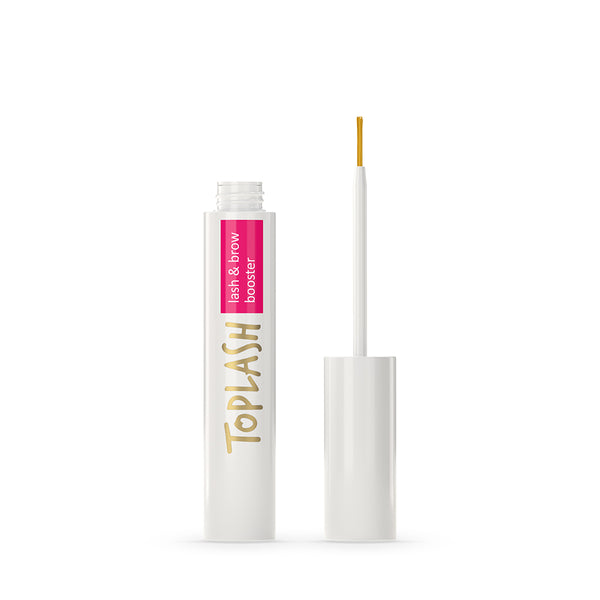
Toplash Lash & Brow Serum
The complete AT-3 + BTP-1 + MP-17 growth-peptide system with independent clinical data: +52.3% length and +31.9% volume at 8 weeks. Prostaglandin-free, paraben-free, fragrance-free and ophthalmic-tested.
Shop Toplash SerumFrequently Asked Questions
Can a lash serum change your eye color?
Only lash serums containing prostaglandin analogs (ICP, DDDE, bimatoprost) carry this risk. They stimulate melanin production in iris melanocytes, potentially darkening the iris — especially in hazel, green, or mixed-colour eyes. Peptide-based serums have no melanocyte-stimulating mechanism and cannot change eye colour.
Is lash serum iris darkening permanent?
Yes — iris colour change from prostaglandin serum use is generally considered irreversible. The American Academy of Ophthalmology states this side effect "cannot be reversed." Unlike eyelid skin darkening (which fades on stopping), iris pigmentation results from increased melanin content within melanocytes — a structural change that persists after discontinuation.
Which eye colours are most at risk?
Eyes with mixed or heterochromic pigmentation — hazel, green-brown, or blue-green — carry the highest risk. The mechanism requires existing eumelanin (brown melanin) that prostaglandins then stimulate to increase. Pure blue eyes lack this substrate and are nearly immune. Dark brown eyes are already maximally pigmented so additional darkening is typically imperceptible.
How does a lash serum change eye colour?
Prostaglandin analogs bind to FP receptors on iris melanocytes and stimulate increased melanogenesis — the production of melanin granules within existing cells. No new melanocytes form; no inflammation occurs. The result is a gradual spreading of brown pigmentation from around the pupil outward, typically noticeable after 6–8 months of daily use.
What is the actual risk level of eye colour change from cosmetic lash serums?
Very low but not zero. Clinical trials with bimatoprost eye drops (direct ocular instillation) showed ~1.5% iris pigmentation at 12 months. Cosmetic serums applied to the lash line deliver much less ocular exposure through migration; documented cosmetic cases are rare but exist in the literature. Users with hazel or green-brown eyes applying PGA serums daily carry the highest relative risk.
Do peptide lash serums change eye colour?
No. Peptide serums have no prostaglandin receptor activity and no known melanocyte-stimulating mechanism. MP-17, BTP-1 and AT-3 work by stimulating keratinocyte growth factor signalling at the hair follicle — a completely separate pathway with no iris involvement. Zero cases of iris colour change have been associated with peptide-only lash serums.
What should I do if I notice my eye colour is changing?
Stop using the serum immediately and consult an ophthalmologist. Early stopping may limit the extent of darkening even if it cannot reverse what has occurred. The ophthalmologist can document baseline iris colour, assess the degree of change, and advise on follow-up monitoring. Do not restart the product or switch to another PGA-containing serum.
References
- Stjernschantz JW, et al. "Mechanism and clinical significance of prostaglandin-induced iris pigmentation." Surv Ophthalmol. 2002;47 Suppl 1:S162–75. PMID: 12204714.
- American Academy of Ophthalmology. Statement on prostaglandin analog iris colour change. Referenced in product labelling for bimatoprost 0.03%. 2024.
- European Medicines Agency. Lumigan (bimatoprost) Summary of Product Characteristics. Section 4.8 Undesirable Effects. View PDF
- Scientific Committee on Consumer Safety. Opinion SCCS/1680/25 on Isopropyl Cloprostenate, DDDE and MDN in cosmetic products. European Commission; 2 February 2026. View PDF
- Toplash Cosmetics. Internal clinical trial data, 8-week independent study. 2025.
- Bimatoprost-Induced Iris Hyperpigmentation. Cutis. 2019. PMID: 31603967.
- Dr. Rupa Wong MD. "Do Lash Serums Change Your Eye Color?" Blog. 2024.
- Lens.com. "What Is the Risk of Iris Darkening From Lash Serums?" 2025.
- SugarbearPRO. "Does Lash Serum Change Eye Color? The Honest Truth." 2025.
- VEGAMOUR. "Side Effects of Prostaglandin in Lash Serums." Blog. 2024.