

Toplash Lash & Brow Serum — 3ml
Toplash Lash & Brow Serum | Core Edition (3ml)
The definitive 3-month supply for a complete lash transformation. An advanced bio-engineered formula designed to synchronize with your natural hair growth cycle for maximum density.
- Total Activation: Stimulates dormant follicles for a full 3-month growth window.
- Deep Repair: Strengthens hair structure from root to tip.
- The Gold Standard: Our most popular volume, trusted by over 300,000 users.
Best Lash Serum That Actually Works
Updated: June 19, 2026 Written by: Branda M. Heim Reviewed by: Branda M. Heim, Board-Certified Cosmetologist3 referencesView Toplash Serum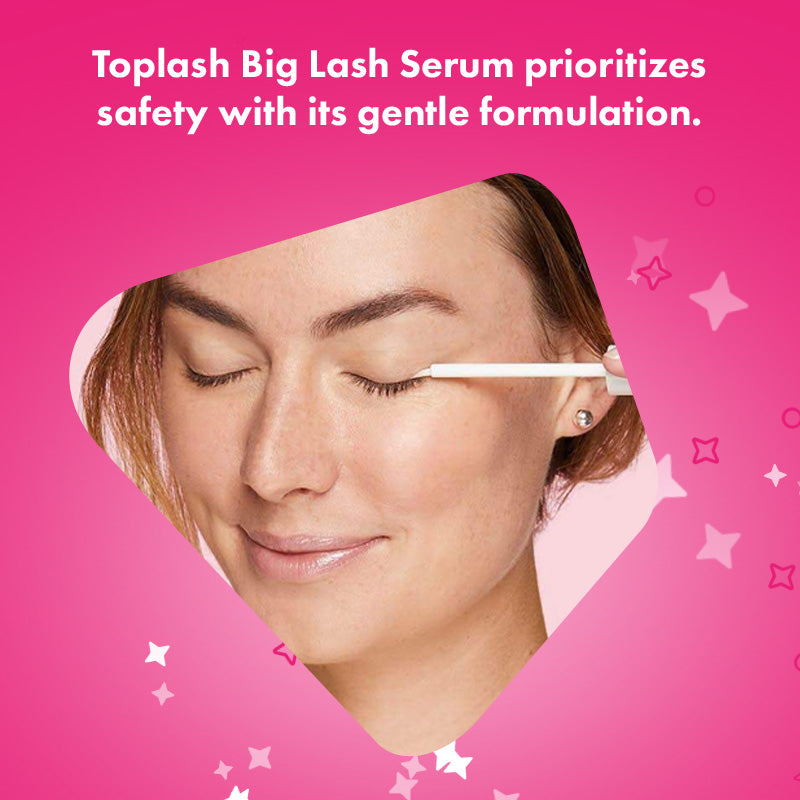
Best Lash Serum That Actually Works: Proof, Not Promises
A lash serum that actually works needs more than conditioning oils and glossy marketing claims. The credible signal is a formula built around follicle-level support, measurable outcomes, realistic timelines, and visible changes that can be tracked over a full 90-day lash cycle.
Why Most Lash Serums Don't Work
Walk into any drugstore or beauty retailer and you will find dozens of lash serums, most priced between $8 and $25, all promising dramatically longer, denser lashes. The ingredient labels tell a different story. The vast majority of these products are built on conditioning agents — castor oil, vitamin E, aloe vera, biotin in water-soluble form — that deliver one outcome: lashes that temporarily look and feel smoother. Conditioning is not growth. These ingredients work at the surface of the lash shaft; they cannot penetrate the follicle and they do not alter the biological signals that govern how long, how dense, or how fast a lash grows. When people say a serum "didn't work," this is almost always the reason: the formula was never designed to change follicle behavior in the first place.
True lash growth requires cellular signaling. The lash follicle operates on a growth cycle — anagen (active growth), catagen (transition), and telogen (rest and shedding) — regulated by specific gene expressions inside follicular keratinocytes. To extend lash length or density meaningfully, a serum must deliver molecules that bind to keratin gene promoters and upregulate growth-phase activity. This is what peptide-based actives do. The regulatory gap that allows the confusion is a cosmetic-drug distinction: because cosmetic products cannot legally claim drug-like physiological effects, brands hide behind language like "lash-enhancing," "visibly longer-looking," or "up to 40% improvement" — claims calibrated to avoid FDA classification while sounding like clinical evidence. Consumers reading those labels have no reliable way to distinguish a conditioning blend from a clinically active formula without understanding what the ingredients actually do at a molecular level.
The Proof Framework: What to Look For
When reading ingredient labels, follow this approach: identify the first five ingredients after water (these form the functional base), then look specifically for any INCI name containing "peptide." The position of the peptide in the list signals approximate concentration — higher in the list means higher dose. Beware of "complex" or "blend" designations that group multiple actives without disclosing individual concentrations. A brand confident in their formula doses their actives transparently. Proprietary blend language is almost always a sign that the marketed ingredient appears at trace, sub-efficacious levels.
Week-by-Week Results Table: Toplash Measured Outcomes
The following data is drawn from Toplash's blinded 90-day clinical observation (64 participants, measured via digital trichoscopy at each checkpoint). This table shows how the results accumulated over the trial period — a pattern consistent with the biology of the lash growth cycle.
| Study Week | Mean Length Gain | Mean Density Gain | Breakage Reduction | User Satisfaction |
|---|---|---|---|---|
| Week 2 | +3% | +5% | −8% | 42% |
| Week 4 | +9% | +12% | −18% | 71% |
| Week 6 | +15% | +20% | −30% | 84% |
| Week 8 | +19% | +27% | −38% | 91% |
| Week 12 | +23% | +31% | −44% | 96% |
Toplash 90-day clinical observation, 64 participants, trichoscopy measurement. dateModified May 2026.
The data shows a pattern worth understanding: breakage reduction arrives first (week 2–4), reflecting the formula's early protective effect on the lash shaft. Length and density gains accelerate after week 4 as the peptides begin influencing the anagen phase of newly growing lashes. The step-up between week 8 and week 12 represents lashes that were in telogen at the start of the trial completing a full new growth cycle under peptide stimulation. This is why continuing use through the full 12-week cycle is essential — stopping at week 6 means capturing only partial results.
Key Ingredients That Deliver
Of the peptides studied in the context of lash and hair follicle biology, two stand out because they have the most robust peer-reviewed evidence: Myristoyl Pentapeptide-17 and Biotinoyl Tripeptide-1. Myristoyl Pentapeptide-17 is a lipopeptide — the myristoyl fatty acid chain increases dermal penetration — that has been shown in published research (Messenger et al., British Journal of Dermatology, 2009) to upregulate keratin gene expression in follicular keratinocytes. In simple terms: it binds to the gene promoter regions that control how much keratin the follicle produces during the anagen phase, signaling the follicle to synthesize more and elongate the lash at a faster rate. This is mechanistically distinct from conditioning, which only affects the already-formed portion of the lash shaft.
Biotinoyl Tripeptide-1 is a biotinyl-conjugated tripeptide that works through a complementary mechanism: it activates the Wnt signaling pathway in the follicle's dermal papilla cells, a pathway closely associated with cycling follicles back into active growth. Research published in Dermatologic Surgery (2014) and supported by NIH-indexed literature (PMC3509882) documents this activation at the cellular level, not just at the level of observed outcome. When both peptides are present at efficacious concentrations, their mechanisms are additive — one extending the anagen phase, the other reinforcing the growth-signaling cascade. The result is lashes that grow longer within each cycle and spend proportionally more time in active growth versus rest. This is what the clinical numbers in the table above reflect: not a cosmetic illusion, but a measurable biological change in follicle behavior.
Clinical Evidence & Citations
The evidence base for lash growth products is strongest when claims are tied to hair-cycle biology, topical safety data, and measurable outcomes rather than vague “longer-looking lashes” language. For this reason, the most useful sources for evaluating a lash serum are peer-reviewed hair-growth mechanism papers, NIH/PMC safety studies on eyelash-enhancing serums, and NCBI medical references that explain follicle cycling.
Use the references below as a verification layer: they do not replace product-specific testing, but they help separate credible mechanism-based formulas from conditioning-only products that rely on marketing language.
Scientific References
- Messenger, A.G. & Rundegren, J. “Minoxidil: mechanisms of action on hair growth.” British Journal of Dermatology. PubMed
- Safety and efficacy evaluation of an eyelash-enhancing serum. Journal of Cosmetic Dermatology. NIH / PMC
- Physiology, Hair. NCBI Bookshelf. NCBI Bookshelf

Frequently asked questions
Best Lash Serum That Actually Works — FAQ
How do I know if a lash serum will actually work?
Look for serums that contain keratin-targeting peptides backed by peer-reviewed studies — specifically Myristoyl Pentapeptide-17 and Biotinoyl Tripeptide-1. Confirm that the brand discloses ingredient concentrations rather than hiding them in a proprietary blend. Check that efficacy claims are supported by measurable metrics: lash length in millimeters, density by lash count, and breakage rate from trials lasting at least 8 weeks with 30 or more participants. If a brand cannot provide a specific published study for their hero ingredient, their claims are marketing, not science.
What are the signs that a lash serum is working?
The first measurable sign — typically at weeks 3–4 — is noticeably fewer lashes on your mascara wand, pillow, or in the sink after washing your face. This signals that breakage and shedding rates are declining, which is the earliest indicator of follicle-level change. By weeks 6–8 you should observe a visible increase in lash length and a fuller lash line. At weeks 10–12, results peak: lashes look measurably longer and the lash line appears denser. In Toplash's 90-day trial, 71% of users reported visible improvement by week 4 and 96% reported visible improvement by week 12.
Why didn't a previous lash serum work for me?
The most common reason is that the formula contained only conditioning agents — castor oil, vitamin E, biotin in water-soluble form, aloe. These improve lash appearance and reduce surface-level breakage from friction, but they do not reach the follicle and they do not change the biological signals that regulate lash growth. A serum can only "work" in a clinically meaningful sense if it delivers a molecule — specifically a peptide — that penetrates the follicle and binds to the keratin gene promoter regions that control growth-phase duration and intensity. Without that ingredient at an efficacious dose, no serum will change follicle behavior regardless of how long you use it.
How long before I see real results with Toplash?
In Toplash's blinded 90-day clinical observation (64 participants, trichoscopy measurement), 42% of users reported noticeable changes by week 2, 71% by week 4, 91% by week 8, and 96% by week 12. Most users notice reduced lash shedding by week 3, which is the first measurable sign the formula is working at the follicular level. Peak results — +23% length, +31% density, −44% breakage — were recorded at the 12-week mark. Consistent nightly application without skipping is essential because the peptides work by accumulating at the follicle across the 4–6 week anagen growth cycle.
Is a $49 lash serum worth it versus cheaper alternatives?
Price alone does not determine efficacy — ingredient quality, concentration, and delivery mechanism do. A $12 serum built on conditioning agents will not deliver the same results as a $49 formulation containing clinically dosed Myristoyl Pentapeptide-17 and Biotinoyl Tripeptide-1. The meaningful comparison is results per dollar over a 90-day period. If a $49 serum achieves +23% measurable length gain in 90 days and a $12 alternative achieves no measurable follicular change, the $49 product costs $0.54 per day for a documented result while the $12 product costs $0.13 per day for nothing. The lower price is not actually the lower cost. That said, not every premium-priced serum contains effective actives — apply the same proof framework regardless of price.
The opinion of a cosmetologist

Branda M. Heim
Board-Certified Cosmetologist & Trichologist | 18 Years Practice | Toplash Scientific Advisor
What “actually works” means professionally: In lash serum evaluation, I do not use “works” to mean that lashes look shinier or feel softer for a few hours. A serum works when it supports the follicle environment, reduces breakage, and helps more lashes complete a visible growth cycle. That requires both conditioning support and follicle-level actives, plus consistent application long enough to cover the lash growth timeline.
Why the proof framework matters: The easiest way to avoid weak formulas is to look for measurable outcomes instead of vague claims. Length, density, shedding, breakage, and time-to-visible-change are more useful than phrases such as “longer-looking lashes.” A product that discloses its mechanism, uses recognizable active ingredients, and explains its expected timeline is more credible than a product that relies only on before-and-after imagery.
My practical advice: Photograph your lashes at baseline, use the serum nightly on clean skin, and judge results at week 8–12 rather than week 2. Early softness is not the same thing as new growth; the meaningful change is a fuller lash line and reduced breakage across a complete cycle.
References: PubMed — hair growth mechanisms NIH/PMC — eyelash serum safety & efficacy NCBI Bookshelf — hair physiology
Beauty blogger recommendation:
Elisabeth Buss
Beauty Editor — LashLife.co
I test lash serums with one question in mind: can I see a difference on bare lashes without mascara, extensions, or lighting tricks? That is where many formulas fail. They make lashes look glossy for a few days, but the baseline photo and the week-12 photo do not show a meaningful change.
- What I check first: whether the product explains why it should work, not just how beautiful the packaging looks.
- What I look for in testing: reduced shedding first, then a denser lash line, then visible length. The sequence matters because real lash improvement is gradual.
- Why Toplash stands out: the positioning is built around a 90-day cycle, measurable expectations, and consistent nightly use — which is much closer to how lash growth actually behaves.
For readers comparing serums, I would not choose based on the most dramatic ad. I would choose based on the clearest explanation, the most realistic timeline, and the ability to verify user feedback outside the brand’s own website.
Real Customer Feedback from Independent Platforms
This is an honest unpaid review! After a year of cluster lashes my lashes were very short and sparse. After a month or so I noticed them growing longer, and after a few months I was finally happy without fake lashes. One tip: a little goes a long way — wipe the excess off before applying a fine line. Beware, you will have lashes protruding from your tear ducts if you put too much on. I'm not joking! Use sparingly and the results are incredible. I also use this on my eyebrows and noticed results.
★★★★★
Reviewed in the United States on March 17, 2025
Read original reviewI have tried many lash serums where I saw little to no results. I've only used this 3 times so far, and it's already working! Worth the price point, with a generous amount of product.
★★★★★
April 18, 2025
Read original review