
Obagi Nu-Cil Lash Serum Review
Physician-Developed Formula · Dehydrolatanoprost Prostaglandin Analogue · NouriPlex Technology · 16-Week Brand Study
Updated: June 20, 2026 Written by: Branda M. Heim Reviewed by: Branda M. Heim, Board-Certified Cosmetologist8 referencesView Toplash SerumBrand & Product Overview
Obagi Medical is a US physician-skincare brand with established credibility in dermatology and medical aesthetics, best known for its prescription-grade Obagi Nu-Derm and Blue Peel protocols. The Obagi Nu-Cil Eyelash Enhancing Serum is their lash growth serum, primarily sold through dermatologist offices, medical spas, and authorised skincare distributors like Dermstore and Skinstore. It is also available on Amazon (ASIN B09C82MWZX).
$67.99–$120 / 3 mL = ~$22.66–40 per mL · Physician-distribution tier
Obagi developed Nu-Cil as a physician-recommended alternative to Latisse (bimatoprost), using Dehydrolatanoprost — a different prostaglandin analogue from the latanoprost family — to activate lash growth through the same FP receptor pathway. The NouriPlex Technology (Biotin + Panthenol + HA) supports conditioning alongside the prostaglandin active.
SCCS/1680/25 (February 2026) specifically assessed and classified ICP (Isopropyl Cloprostenate), DDDE, and MDN as "cannot be considered safe." Dehydrolatanoprost is NOT included in this specific opinion — making Nu-Cil's regulatory position different from ICP-containing serums like GrandeLASH, Borboleta, or Rodan+Fields.
However, Dehydrolatanoprost is pharmacologically in the same class (prostaglandin FP agonist, latanoprost prodrug) with the same mechanism. The SCCS has previously expressed class-level concerns about prostaglandin analogues in cosmetics. The side effect profile is the same class — only the specific regulatory naming differs.
For the EU market: Nu-Cil is not specifically banned under SCCS/1680/25. For consumer safety considerations globally, the same FP-receptor mechanisms apply regardless of which specific prostaglandin analogue is used.
Dehydrolatanoprost: What It Is and How It Works
Dehydrolatanoprost is a synthetic prodrug that, when applied topically, converts to latanoprost — the active FP receptor agonist used as an FDA-approved ophthalmic drug for glaucoma (under the brand Xalatan, among others). The "dehydro" prefix indicates a structural modification that improves topical skin penetration and corneal permeation compared to latanoprost itself.
Mechanism of Action
Like all prostaglandin FP agonists (bimatoprost, latanoprost, ICP, DDDE), Dehydrolatanoprost activates the FP prostaglandin receptor in the hair follicle. FP receptor activation extends the anagen (active growth) phase, increases the number of lash follicles in anagen simultaneously, and slightly increases the diameter of the hair matrix. This is the same fundamental mechanism as Latisse (bimatoprost), working at the same receptor but through a cosmetic rather than pharmaceutical-grade product.
ICP (Isopropyl Cloprostenate) — a synthetic cloprostenol derivative. Covered by SCCS/1680/25. Banned in Canada 2019. Activates FP receptor.
Dehydrolatanoprost — a synthetic latanoprost prodrug. NOT specifically named in SCCS/1680/25. Not specifically listed on Health Canada's current hotlist. Activates the same FP receptor. Same class of side effects.
Regulatory status differs by jurisdiction and timing. Pharmacological class, mechanism, and potential side effects are the same.
Why Physician Distribution Matters — and Its Limits
Obagi's decision to sell Nu-Cil primarily through physician offices reflects an attempt to provide appropriate clinical oversight for a prostaglandin-containing product. Physicians can monitor for side effects, assess individual risk (particularly for glaucoma patients on FP agonist eye drops), and advise on appropriate use.
However, Nu-Cil is also available on Amazon and through general skincare retailers without clinical oversight. Consumers purchasing online receive no physician guidance on risk assessment, contraindications, or monitoring.
Full Ingredient Analysis (12 INCI)
| # | INCI Name | Function |
|---|---|---|
| 1 | Aqua / Water / Eau | Solvent base |
| 2 | Dehydrolatanoprost Prostaglandin Analogue | Latanoprost prodrug · FP prostaglandin receptor agonist · extends anagen phase · increases follicle recruitment · same class as ICP, bimatoprost · ⚠️ associated with class-level ocular side effects |
| 3 | Biotin (Vitamin B7) NouriPlex | Keratin infrastructure cofactor · hair thickness support |
| 4 | Panthenol (Provitamin B5) NouriPlex | Conditioning · moisture · cortex penetrant |
| 5 | Sodium Hyaluronate NouriPlex HA | Hyaluronic acid · hydration · plumping |
| 6 | Phenoxyethanol Preserve | Broad-spectrum preservative |
| 7 | C12-15 Alkyl Benzoate | Emollient · lightweight skin-feel modifier |
| 8 | Caprylyl Glycol Preserve | Humectant · antimicrobial booster · preservative |
| 9 | Acrylates/C10-30 Alkyl Acrylate Crosspolymer | Thickener · gel texture · Carbomer-like |
| 10 | Alcohol (Ethanol) | Solvent · penetration enhancer · fast-drying carrier |
| 11 | Sodium Hydroxide | pH adjuster |
| 12 | Phenethyl Caffeate NouriPlex Lipid | Caffeic acid phenethyl ester (CAPE) · antioxidant · anti-inflammatory · lipid phase component · anti-androgenic properties (preliminary) |
Dehydrolatanoprost at position 2 — immediately after water — indicates it is at a relatively high concentration compared to ICP in many competitor formulas where it appears lower in the INCI. This is consistent with Obagi's physician-oriented formulation approach (likely optimised for clinical efficacy within the intended use parameters).
Phenethyl Caffeate (CAPE) — the "proprietary lipid compound" in NouriPlex — is an interesting addition. CAPE is the active ester found in bee propolis, with well-documented antioxidant and anti-inflammatory properties. Preliminary research suggests weak 5-alpha reductase inhibiting properties. Unusual but genuine addition at the low concentration its INCI position implies.
Clinical Evidence
Evidence Classification: All data below are from an Obagi-sponsored brand study. This is a physician-supervised brand study, not an independently conducted peer-reviewed trial.
Obagi's brand-sponsored 16-week clinical study (conducted with physician oversight at aesthetic medicine centres) reported:
- 93% of participants reported visible improvement in eyelash appearance
- 89% reported lashes looking thicker
- 89% reported lashes appearing denser
The 16-week study duration is the longest of any brand clinical data reviewed in this series. The prostaglandin mechanism of Dehydrolatanoprost is well-validated in ophthalmology (latanoprost for glaucoma has decades of evidence), so the efficacy claim is pharmacologically credible. However, the study is brand-commissioned and not independently audited.
Comparison: Toplash's independent clinical trial (8 weeks, independent laboratory, digital image analysis) measured +52.3% lash length and +31.9% volume. The evidence methodologies differ: Obagi's is a physician-supervised brand study; Toplash's is independently conducted with objective measurement.
Side Effects
Because Obagi Nu-Cil contains Dehydrolatanoprost — an FP receptor agonist — it shares the prostaglandin class side-effect profile documented across bimatoprost (Latisse), ICP (GrandeLASH, RapidLash, etc.), and other FP agonists:
- Iris pigmentation — Permanent darkening of blue, green, or hazel eyes through FP receptor-mediated melanogenesis.
- Periorbital fat atrophy — Reduction of orbital fat via FP receptor lipolysis — sunken eye appearance.
- Eyelid hyperpigmentation — Darkening at the lash line skin.
- Upper eyelid sulcus deepening — Upper lid contour change from fat volume loss.
- Ocular irritation — Burning, redness, tearing, sensitivity.
- Glaucoma drug interference — FP receptor cross-reactivity with latanoprost, bimatoprost, travoprost glaucoma medications.
Obagi's website acknowledges these class risks, consistent with the physician-distribution model that enables patient counselling. For consumers purchasing through general retail channels, this oversight is absent.
Obagi Nu-Cil vs. Toplash: Full Comparison
| Parameter | Obagi Nu-Cil | Toplash |
|---|---|---|
| Active growth ingredient | ⚠️ Dehydrolatanoprost (PGA) | ✅ AT-3 + BTP-1 + MP-17 (PGA-free peptides) |
| Prostaglandin FP agonist | ⚠️ Yes (latanoprost prodrug) | ✅ None |
| SCCS/1680/25 status | ℹ️ Not specifically covered (different PGA) | ✅ Fully compliant |
| Iris pigmentation risk | ⚠️ Yes (same FP class) | ✅ None |
| Periorbital fat atrophy risk | ⚠️ Yes (same FP class) | ✅ None |
| Brand study duration | 16 weeks (longest reviewed) | 8 weeks (independent) |
| Physician endorsement | ✅ Physician-developed, medical distribution | Ophthalmologist-tested |
| Clinical evidence independence | Brand-sponsored study | ✅ Independent laboratory |
| Measured lash length gain | Not objectively measured (% participant report) | +52.3% (independent digital analysis) |
| Price per mL | ~$22.66–40/mL | $16.63/mL |
| Availability without physician | Amazon, Dermstore (no Rx required) | Toplash.com |
| Paraben-free | ✅ Yes | ✅ Yes |
Frequently Asked Questions
Does Obagi Nu-Cil contain prostaglandins?
Yes. Obagi Nu-Cil contains Dehydrolatanoprost — a synthetic prodrug that converts to latanoprost (an FDA-approved FP prostaglandin receptor agonist used for glaucoma) upon topical application. It activates the same FP receptor as bimatoprost (Latisse), ICP (GrandeLASH), and other prostaglandin lash serums, producing lash growth through the same mechanism and carrying the same class of potential side effects. Note: Dehydrolatanoprost is NOT specifically named in SCCS/1680/25 (which covers ICP, DDDE, MDN), distinguishing it from those specific banned compounds — but the pharmacological class is the same.
Is Dehydrolatanoprost banned by SCCS or Health Canada?
As of June 2026: SCCS/1680/25 (February 2026) specifically classified ICP, DDDE, and MDN as "cannot be considered safe" — Dehydrolatanoprost is not listed in that specific opinion. Health Canada's Cosmetic Ingredient Hotlist bans ICP specifically; Dehydrolatanoprost does not appear separately on the current Canadian prohibited list. This creates a different regulatory situation from ICP-containing serums. However, the FP receptor mechanism and associated side effect class are identical, meaning the safety considerations for consumers are the same regardless of which specific prostaglandin analogue is used.
What are the side effects of Obagi Nu-Cil?
Because Dehydrolatanoprost is an FP prostaglandin receptor agonist, Obagi Nu-Cil carries the same class of side effects as ICP-containing serums: iris pigmentation (permanent darkening of blue/green/hazel eyes), periorbital fat atrophy (sunken eye appearance), eyelid hyperpigmentation, deepening of the upper eyelid sulcus, ocular irritation, and potential interference with prostaglandin glaucoma medications. Obagi's product information acknowledges these class risks.
What is NouriPlex Technology in Obagi Nu-Cil?
NouriPlex Technology is Obagi's branded supporting complex: Biotin (keratin cofactor), Panthenol (Provitamin B5 conditioning), Sodium Hyaluronate (HA hydration), and Phenethyl Caffeate (CAPE — the active ester from bee propolis with antioxidant and mild anti-androgenic properties). These four ingredients provide conditioning and antioxidant support alongside the Dehydrolatanoprost growth mechanism.
What are the clinical results for Obagi Nu-Cil?
Obagi's brand-sponsored 16-week clinical study reported: 93% of participants saw visible improvement, 89% reported thicker lashes, 89% reported denser lashes. This is the longest brand study duration reviewed in this series (16 vs 4–12 weeks for most competitors). It is a brand-commissioned study, not independently peer-reviewed. Toplash's independent 8-week trial measured +52.3% lash length and +31.9% volume using objective digital image analysis.
How much does Obagi Nu-Cil cost?
Obagi Nu-Cil Eyelash Enhancing Serum (3 mL, ASIN B09C82MWZX) retails at approximately $67.99 on Dermstore/Skinstore to $120 at physician offices and some retailers — equating to approximately $22.66–40/mL. Toplash costs $16.63/mL with independent evidence. The physician-distribution premium partially explains the higher cost, but the per-mL price is still significantly higher than PGA-free alternatives.
How does Obagi Nu-Cil compare to Toplash?
Obagi Nu-Cil contains Dehydrolatanoprost — an FP prostaglandin agonist that carries the same class of potential side effects as ICP-containing serums (iris darkening, periorbital fat atrophy, eyelid pigmentation). It has a 16-week brand study showing 93% efficacy and physician-grade endorsement. Toplash is completely prostaglandin-free, uses three dedicated follicle growth peptides (AT-3 + BTP-1 + MP-17), has an independent 8-week clinical trial (+52.3% lash length), and costs less ($16.63 vs $22.66–40/mL). For consumers prioritising the absence of prostaglandin side-effect risk alongside independently verified growth outcomes, Toplash is the stronger choice.
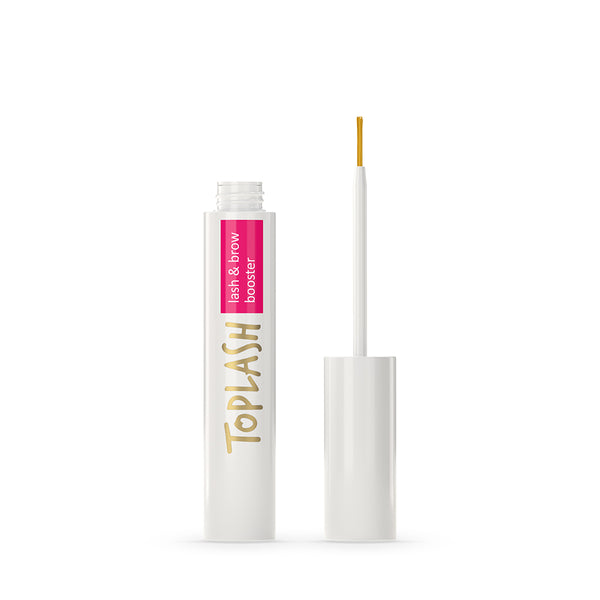
Recommended alternative — complete triple-peptide system
Toplash Lash & Brow Serum
The complete AT-3 + BTP-1 + MP-17 growth-peptide system with independent clinical data: +52.3% length and +31.9% volume at 8 weeks. Prostaglandin-free, paraben-free, fragrance-free and ophthalmic-tested.
Shop Toplash SerumReferences
- Obagi Medical. "Nu-Cil Eyelash Enhancing Serum." obagi.com. Accessed June 2026. ASIN B09C82MWZX.
- Incidecoder. "Obagi Nu-cil Eyelash Enhancing Serum — Ingredients Explained." incidecoder.com. Accessed June 2026.
- SkinSafe. "Dehydrolatanoprost Ingredient Allergy Safety Information." skinsafeproducts.com. Accessed June 2026.
- SCCS (Scientific Committee on Consumer Safety). Opinion on ICP, DDDE and MDN in cosmetics. SCCS/1680/25. February 2, 2026.
- Health Canada. "Cosmetic Ingredient Hotlist: Isopropyl Cloprostenate." canada.ca. Updated 2019.
- Woodward DF et al. "Pharmacological characterization of a novel antiglaucoma agent, Bimatoprost (AGN 192024)." Journal of Pharmacology and Experimental Therapeutics. 2003;305(2):772–785.
- Toplash Independent Clinical Trial Data. Triple-Peptide AT-3 + BTP-1 + MP-17 (8-week, digital image analysis). Internal report on file.
- Amazon.com. "Obagi Nu-Cil Eyelash Enhancing Serum." ASIN B09C82MWZX. Accessed June 2026.