
Lash Serum vs Latisse: Efficacy, Side Effects & Which to Choose (2026)
Latisse (bimatoprost) is FDA-approved and clinically proven — but carries documented risks of iris darkening, fat atrophy and eyelid darkening. Peptide lash serums offer real results with a markedly different safety profile. Full comparison, 2026.
Updated: June 20, 2026 Written by: Branda M. Heim Reviewed by: Branda M. Heim, Board-Certified Cosmetologist9 referencesView Toplash SerumLatisse is a prescription drug with strong clinical evidence and FDA approval — but it carries documented risks of permanent iris darkening, periorbital fat atrophy and eyelid darkening. High-quality peptide lash serums (like Toplash) produce real, clinically documented cosmetic results without these pharmacological risks, and are available OTC without a prescription. For most cosmetic users, a peptide serum offers the better risk-benefit balance.
What Is Latisse and How Is It Different from OTC Lash Serums?
Latisse is a prescription ophthalmic solution containing bimatoprost 0.03% — a prostaglandin analog originally developed as a glaucoma drug (Lumigan). When applied to the upper lash line, bimatoprost extends the anagen (active growth) phase of the lash cycle and increases the number of hairs in anagen, producing longer, thicker and darker lashes. Latisse received FDA approval in 2008 as the only prescription drug approved specifically for eyelash hypotrichosis (inadequate lashes).[1]
OTC lash serums are cosmetic products — not drugs — sold without prescription. The category divides into two fundamentally different types:
- PGA-containing OTC serums (e.g. GrandeLASH, RevitaLash): contain prostaglandin analogs (ICP, DDDE) that work through the same FP receptor mechanism as Latisse, but are sold as cosmetics without FDA drug approval — and without the medical oversight that prescription use requires.
- Peptide-based OTC serums (e.g. Toplash): contain peptide growth factor actives (MP-17, BTP-1, AT-3) that work through keratinocyte growth factor signalling at the follicle — a completely different, non-hormonal mechanism with a very different safety profile.
This comparison focuses on Latisse vs peptide OTC serums, since that represents the meaningful choice for most cosmetic users.
Head-to-Head Comparison
| Parameter | Latisse (Bimatoprost 0.03%) | Toplash Peptide Serum |
|---|---|---|
| Active ingredient | Bimatoprost 0.03% (prostaglandin analog) | MP-17, BTP-1, AT-3 (peptide complex) |
| Mechanism | FP receptor agonism → anagen extension + melanin increase | KGF receptor signalling → anagen extension + follicle nourishment |
| Regulatory status | FDA-Approved Drug (Rx) | OTC Cosmetic — No PGA concern |
| Prescription required | Yes — physician prescription | No — available OTC |
| Clinical evidence | FDA approval trial: significant length, thickness, darkness increases | Independent 8-week trial: +52.3% length, +31.9% volume |
| Iris colour change risk | Yes — may be permanent | None — no melanocyte mechanism |
| Periorbital fat atrophy | Documented — only partially reversible | Not reported |
| Eyelid darkening | Documented — usually reversible | Not reported |
| Typical cost | ~$150–200 / 5 mL + physician visit fees | $49.90 / 3 mL (~90 days) |
| Lash darkening effect | Yes — melanin stimulation darkens lash colour | No — length and volume only; colour unchanged |
| SCCS 2026 ruling | Pharmaceutical drug (outside SCCS cosmetics scope) | No SCCS concern — peptides not assessed |
Side Effect Profiles Compared
Latisse (Bimatoprost)
- Eye pruritus (itching): <4% in controlled trials[1]
- Conjunctival hyperemia (redness): <4% in controlled trials
- Ocular irritation, dry eye, eye pain
- Eyelid skin darkening (hyperpigmentation) — usually reversible
- Periorbital fat atrophy (hollow eye appearance) — partially reversible
- Iris colour change from chronic use — may be permanent[2]
- Unwanted hair growth if serum touches other facial skin
- Requires physician prescription and monitoring
Toplash Triple-Peptide Serum
- No prostaglandin receptor activity — no pharmacological ocular effects
- No melanocyte stimulation — no iris or eyelid darkening
- No orbital fat atrophy mechanism
- No prescription required
- No reported ocular adverse events in independent 8-week trial
- Fragrance-free, BAK-free, alcohol-free formula
- Suitable for sensitive eyes and contact lens wearers
- Comparable irritation profile to a standard hydrating serum
"The distinction between Latisse and a peptide serum is not simply prescription vs OTC — it is pharmacological vs cosmetic. Latisse is a drug that works by engaging the same hormonal receptor pathway as a glaucoma treatment. That is why it produces stronger lash darkening than any peptide serum can. It is also why it carries a risk of permanent iris colour change. For patients with medically inadequate lashes, that trade-off may be acceptable. For the majority of cosmetic users who want fuller, longer lashes, a peptide serum achieves the goal without the pharmacological risk."
Who Should Choose Latisse and Who Should Choose a Peptide Serum
| Profile | Recommended Option | Reason |
|---|---|---|
| Diagnosed eyelash hypotrichosis (medical inadequacy) | Latisse (Rx) | Only FDA-approved drug for this condition; medical supervision appropriate |
| Cosmetic enhancement of healthy lashes | Peptide serum (OTC) | Real results without pharmacological risk; no prescription burden |
| Sensitive eyes or history of ocular reactions | Peptide serum | No prostaglandin receptor activity; no documented conjunctival or ocular effects |
| Hazel, green or mixed-colour eyes (iris change risk) | Peptide serum | Latisse carries iris darkening risk (may be permanent); peptide has zero iris mechanism |
| Contact lens wearers | Peptide serum (BAK-free) | Bimatoprost vehicles may contain BAK; BAK-free peptide formula is safer for lens wearers |
| Wants lash darkening in addition to growth | Latisse | Latisse stimulates melanin in lash shafts, producing measurably darker lashes; peptides do not |
| Budget-conscious user | Peptide serum | ~$200/year vs ~$600–700/year for Latisse with medical visits |
| Pregnant or breastfeeding | Neither (consult physician) | Bimatoprost is contraindicated in pregnancy; peptide serum safety in pregnancy not established |
Cost Comparison
Cost is a practical consideration that often determines long-term adherence to a lash product:
- Latisse 5 mL bottle: $150–200. At daily use (one applicator per day), the 5 mL bottle lasts approximately 4 months. Annual cost: approximately $450–600 for product alone.
- Physician consultation for Rx: Latisse requires a prescription, which typically means a dermatology or ophthalmology consultation. Adding 1–2 consultations per year adds $100–300 to annual cost.
- Total annual Latisse cost: ~$600–900/year including medical visits.
- Toplash 3 mL (OTC): $49.90. At daily use, lasts ~90 days. At maintenance 3×/week, lasts ~5 months. Annual cost: approximately $120–200.
For cosmetic users maintaining a lash routine long-term, the annual savings from a peptide OTC serum vs Latisse are significant — without a sacrifice in visible result for most users.
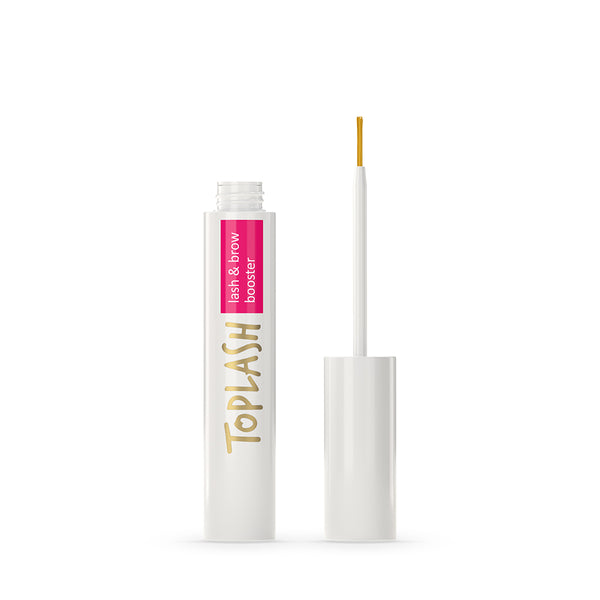
Toplash Lash & Brow Serum
The complete AT-3 + BTP-1 + MP-17 growth-peptide system with independent clinical data: +52.3% length and +31.9% volume at 8 weeks. Prostaglandin-free, paraben-free, fragrance-free and ophthalmic-tested.
Shop Toplash SerumFrequently Asked Questions
What is the difference between Latisse and OTC lash serums?
Latisse is a prescription drug (bimatoprost 0.03%) — the only FDA-approved treatment for inadequate eyelashes, requiring a physician prescription and medical supervision. OTC lash serums are cosmetic products. Peptide-based OTC serums use MP-17, BTP-1 and AT-3 to stimulate lash growth through follicle signalling; they carry a very different safety profile — no iris colour change, no fat atrophy risk.
Is Latisse more effective than OTC lash serums?
Latisse has the strongest clinical evidence base, with FDA approval supported by controlled trials. Top-quality OTC peptide serums also show meaningful clinical results (Toplash: +52.3% length, +31.9% volume at 8 weeks). Head-to-head trials do not exist. Latisse also produces lash darkening (melanin stimulation) that peptide serums cannot replicate. The key trade-off is that Latisse's stronger mechanism comes with documented risks that peptide serums do not share.
What are the side effects of Latisse compared to lash serums?
Latisse controlled trials: eye pruritus and conjunctival hyperemia in <4% of subjects. Long-term: iris colour change (may be permanent), periorbital fat atrophy, and eyelid hyperpigmentation. Peptide serums (e.g. Toplash): no pharmacological ocular effects, no melanocyte stimulation, no fat atrophy mechanism. In Toplash's 8-week trial, no ocular adverse events were reported.
Can I use an OTC lash serum instead of Latisse?
For cosmetic lash enhancement, a high-quality OTC peptide serum is a legitimate alternative to Latisse without the need for a prescription or pharmacological risk. Latisse is specifically indicated for medically inadequate lashes (hypotrichosis); for cosmetic purposes, a peptide serum is the safer choice for most users.
How does Latisse change lashes and is it permanent?
Latisse extends the anagen phase via FP receptor agonism, making lashes grow longer, thicker and darker. The lash enhancement is not permanent — lashes return to natural baseline within 2–4 months of stopping. However, iris colour darkening from chronic Latisse use may be irreversible, representing a permanent risk from a temporary cosmetic benefit.
Why was Latisse's ingredient bimatoprost not covered by SCCS/1680/25?
SCCS/1680/25 (EU, February 2026) assessed prostaglandin analog compounds used in cosmetic products — specifically ICP, DDDE and MDN. Bimatoprost is a pharmaceutical prescription drug regulated under EU medicines law, not cosmetics regulation. This does not mean bimatoprost is safer — it is subject to a stricter regulatory pathway that acknowledges its pharmacological risks through required medical oversight.
How much does Latisse cost compared to an OTC lash serum?
Latisse: ~$150–200 per 5 mL bottle (4-month supply) plus physician visit fees — approximately $600–900/year. Toplash: $49.90 per 3 mL bottle (90-day supply at daily use; ~5 months at maintenance) — approximately $120–200/year. Annual savings from choosing a peptide OTC serum vs Latisse can exceed $500.
References
- FDA. Latisse (bimatoprost ophthalmic solution, 0.03%) Prescribing Information. Allergan. 2008–2024. View FDA Label
- Yam JCS, Yuen NS. "Iris colour change associated with bimatoprost." J Ocul Pharmacol Ther. 2014.
- Scientific Committee on Consumer Safety. Opinion SCCS/1680/25 on ICP, DDDE and MDN in cosmetic products. European Commission; 2 February 2026. View PDF
- Goldberg RA, et al. "Periorbital fat atrophy: an under-recognised side effect of topical prostaglandin." Ophthalmic Plast Reconstr Surg. 2009.
- Toplash Cosmetics. Internal clinical trial data, 8-week independent study. 2025.
- Nurx. "Prescription vs. OTC Lash Serum: What's the Difference?" 2025.
- Hair GP. "Prescription vs OTC Lash Serums: A Detailed Guide." 2024.
- Redbox Rx. "Latisse Alternatives: Compare Top Eyelash Serums." 2025.
- Kilo Biotechnology. "Isopropyl Cloprostenate vs. FDA-Approved Lash Serums: Which Is Safer?" 2025.