
Lash Serum for Sensitive Eyes: Safe Options, Irritants to Avoid & How to Apply (2026)
Have sensitive eyes? Learn which lash serum ingredients trigger irritation, redness and swelling — and how to choose a peptide-based, fragrance-free formula backed by the 2026 SCCS safety ruling.
Updated: June 20, 2026 Written by: Branda M. Heim Reviewed by: Branda M. Heim, Board-Certified Cosmetologist10 referencesView Toplash SerumSensitive eyes affect an estimated 50–60% of contact lens wearers and a significant proportion of the general population.[1] For this group, selecting a lash serum is not simply a cosmetic choice — it is a safety decision. The wrong formula can trigger allergic conjunctivitis, chemical irritation, or periorbital oedema that takes weeks to resolve.
The good news: not all lash serums carry the same risk. Peptide-based formulas designed without prostaglandin analogs, synthetic fragrance, alcohol or known preservative irritants are tolerated by the vast majority of sensitive-eye users. This guide explains exactly what to look for, what to avoid, and how to apply safely.
Why Sensitive Eyes React to Lash Serums
The periorbital area — the skin and mucosa around the eye — is among the thinnest and most permeable tissue in the body. Ingredients applied to the lash line are within 1–2 mm of the ocular surface and conjunctival mucosa. For people with baseline sensitivity, even trace migration of an irritant can trigger a reaction disproportionate to the applied dose.
Chemical Irritation
Alcohol, fragrance and strong preservatives (BAK) directly damage the tear film and corneal epithelium. Symptoms appear within 30 minutes: burning, stinging, tearing.
Allergic Reaction
Sensitising allergens (parabens, phthalates, fragrance compounds) trigger a Type IV delayed hypersensitivity. Symptoms develop 24–72 hours after first exposure: itching, redness, swelling.
Prostaglandin Pharmacology
PGA compounds act on prostaglandin receptors in the conjunctiva and iris, causing hyperemia (~10% of users), periorbital oedema (~4%) and, with chronic use, iris colour change and fat atrophy.[2]
Contact Lens Interaction
Soft lenses concentrate serum residue against the cornea and absorb preservatives. Even a well-tolerated serum can cause burning and cloudiness if lenses are worn during or immediately after application.
Ingredients Sensitive Eyes Must Avoid
Five categories of ingredients account for the overwhelming majority of lash serum reactions in sensitive-eye users. If any of the following appear on the INCI label, treat the product as high-risk:
| Ingredient Category | Common INCI Names | Reaction Type | Risk Level |
|---|---|---|---|
| Prostaglandin analogs | Isopropyl Cloprostenate (ICP), Dechloro Dihydroxy Difluoro Ethylcloprostenolamide (DDDE), Methyl Amide Dihydro Noradrenaline (MDN), Bimatoprost | Conjunctival hyperemia, oedema, iris pigmentation, fat atrophy | HIGH |
| Synthetic fragrance | Parfum, Fragrance, Linalool, Limonene, Citronellol | Allergic conjunctivitis, contact dermatitis, tearing | HIGH |
| Benzalkonium Chloride (BAK) | Benzalkonium Chloride | Tear film disruption, corneal epithelial damage, dry eye | HIGH |
| Denatured / SD Alcohol | Alcohol Denat., SD Alcohol 40, Ethanol | Drying, stinging, increased permeability of subsequent irritants | MODERATE |
| Parabens & Phthalates | Methylparaben, Propylparaben, Dibutyl Phthalate (DBP) | Delayed allergic sensitisation; endocrine interaction with long-term use | MODERATE |
The 2026 EU Scientific Committee on Consumer Safety Opinion (SCCS/1680/25) concluded that prostaglandin analog compounds ICP, DDDE and MDN "cannot be considered safe for use in cosmetic products." This regulatory finding directly supports the avoidance recommendation above for the highest-risk category.[3]
What to Look for in a Serum for Sensitive Eyes
The characteristics below define a sensitive-eye compatible lash serum. Ophthalmologists and cosmetic dermatologists consistently reference these criteria in clinical guidance:
- Prostaglandin-free (PGA-free): Eliminates the highest-risk irritant category and the systemic ocular effects documented by SCCS/1680/25.
- Fragrance-free (not just "unscented"): "Unscented" products can still contain masking fragrances. Look for the claim "fragrance-free" on the label.
- Preservative-free or BAK-free: Acceptable preservatives for ocular-adjacent use include phenoxyethanol (at ≤1%) and sodium benzoate rather than BAK or chlorobutanol.
- Alcohol-free: Avoids the drying and barrier-disrupting effects of denatured alcohol.
- Peptide-based active: Peptides such as Myristoyl Pentapeptide-17 (MP-17), Biotinoyl Tripeptide-1 (BTP-1) and Acetyl Tetrapeptide-3 (AT-3) signal growth factor receptors rather than hormonal pathways, producing no known ocular surface effects.
- Ophthalmologist-tested or -developed: While not a regulatory requirement, this label claim indicates the product was assessed for ocular safety before launch.
- Contact-lens compatible: Formulas that are explicitly tested with soft contact lenses reduce risk for lens wearers.
Prostaglandin vs Peptide: Sensitive-Eye Risk Comparison
The difference in sensitive-eye tolerability between PGA serums and peptide serums is not marginal — it is categorical. The table below compares the key parameters:
| Parameter | Peptide Serums (e.g. Toplash) | PGA Serums (e.g. GrandeLASH, RevitaLash) |
|---|---|---|
| Conjunctival hyperemia (red eyes) | No documented mechanism | ~10% incidence[2] |
| Periorbital oedema (eyelid swelling) | Not reported | ~4% incidence (one in 25 users)[4] |
| Iris colour change | Not possible — no iris receptor activity | Documented; potentially irreversible[5] |
| Mechanism of action | KGF receptor signalling → anagen extension | FP receptor agonism → hormonal pathway |
| Regulatory status 2026 | SAFE — no SCCS concern | CONCERN — SCCS/1680/25 negative Opinion |
| Suitable for sensitive eyes? | YES — when fragrance- & BAK-free | HIGH RISK — avoid in sensitive users |
"The periorbital skin is a uniquely vulnerable application site. For clients with any degree of eye sensitivity, I specify peptide-only formulas without fragrance or BAK. The clinical case for avoiding prostaglandin analogs in this population is now reinforced by the 2026 SCCS regulatory ruling — the risk-benefit calculation no longer favours them even for users with no prior reaction history."
Safe Application Routine for Sensitive Eyes
Correct application technique reduces irritation risk independent of formula. Follow this routine to minimise product migration toward the ocular surface:
-
Cleanse and fully dry the eye area
Remove all makeup, including mascara residue. Pat skin completely dry — serum applied to damp skin spreads more readily and increases migration toward the eye. Wait a full 5 minutes after cleansing before applying.
-
Remove contact lenses first
Remove all lenses before application. Do not reinsert until the serum has fully dried — a minimum of 15–20 minutes. Residue from even a gentle serum can cloud soft lens material and concentrate preservatives against the cornea.
-
Apply a single, thin stroke to the upper lash line only
Sweep the applicator brush along the base of the upper lash line from the inner to outer corner. Use the thinnest possible coat — excess product is the primary cause of migration. Never apply to the lower lash line, waterline or eyelid skin.
-
Apply at night
Night-time application means closed eyes for 6–8 hours, which limits the window during which migrated product can contact the ocular surface. Avoid applying within 30 minutes of lying down if you are a back-sleeper — the angle can cause product to pool toward the eye.
-
Start every other day for the first two weeks
An alternate-day schedule in the sensitisation window allows you to identify any delayed hypersensitivity reaction (which typically peaks 24–72 hours after application) before cumulative exposure builds. If no reaction occurs after 14 days, switch to nightly use.
-
Do not layer with other eye-area actives on the same night
Retinol, AHA/BHA exfoliants, and vitamin C serums all increase periorbital skin permeability. Using them on the same night as your lash serum elevates migration risk. Alternate nights where possible, or apply eye actives to a zone at least 5 mm above the lash line.
Contact Lens Wearers: Specific Guidance
👁️ Contact Lens Protocol
Contact lens wearers face two distinct risks: (1) serum residue clouding the lens surface, and (2) preservatives or active ingredients concentrating against the cornea through lens absorption. Follow these additional steps:
- Remove lenses before application — always, without exception.
- Wait 15–20 minutes minimum after application before reinserting lenses — until the formula has fully dried and set.
- If you experience lens cloudiness after reinsertion on subsequent days, switch to applying serum in the morning after lens insertion, not before — wait until one hour before removal.
- Hard (RGP) lenses carry less absorption risk than soft lenses but the same migration risk — the same protocol applies.
- Avoid serums with BAK entirely — benzalkonium chloride is known to damage the silicone-hydrogel matrix of modern soft lenses and impairs the corneal surface with extended exposure.
Ophthalmologists generally advise lens wearers to use only contact-lens-compatible formulas at the lash line.[1] When in doubt, ask your optometrist to review the INCI ingredient list before starting any new lash serum.
Warning Signs: When to Stop Using a Lash Serum
Some initial dryness or mild tightness in the first 1–3 days of a new product can be normal skin adjustment. However, the following symptoms signal that a product is incompatible with your eye sensitivity level and use should be discontinued:
⚠ Stop Use Immediately If You Notice:
- Persistent redness or bloodshot appearance lasting more than 48 hours after application
- Burning or stinging sensation that does not resolve within 30 minutes
- Swelling of the eyelid or periorbital skin (periorbital oedema)
- Watery eyes, discharge, or increased mucous production
- Any noticeable change in iris colour — even slight browning in blue or green eyes
- Sunken or hollowed appearance in the orbital area (sign of fat atrophy — seek a dermatologist)
- Eyelid drooping (ptosis) or difficulty fully opening the eye
The first four symptoms on the list are common to chemical irritation or allergic reaction and typically resolve within 7–14 days of discontinuation. The last three — iris colour change, fat atrophy and ptosis — are associated specifically with prostaglandin analog serums and may be partially or fully irreversible. Seek an ophthalmology assessment promptly if you develop any of these three.[5]
The Sensitive-Eye Safe Choice: Toplash Triple-Peptide Serum
Toplash was formulated with ocular-adjacent safety as a primary design criterion. The complete formula avoids every ingredient category listed in the avoidance table above: no prostaglandins, no fragrance, no BAK, no denatured alcohol, no parabens, no phthalates.
Its active complex — Myristoyl Pentapeptide-17 (MP-17), Biotinoyl Tripeptide-1 (BTP-1) and Acetyl Tetrapeptide-3 (AT-3) — works by stimulating keratinocyte and dermal papilla growth factor signalling. This mechanism is entirely local to the follicle and produces no known prostaglandin-pathway activity, meaning none of the systemic ocular effects associated with PGA serums are mechanistically possible.
In an independent 8-week clinical trial, +52.3% lash length and +31.9% volume were recorded with no ocular adverse events reported. 98% of participants saw a visible change by Day 21.[6]
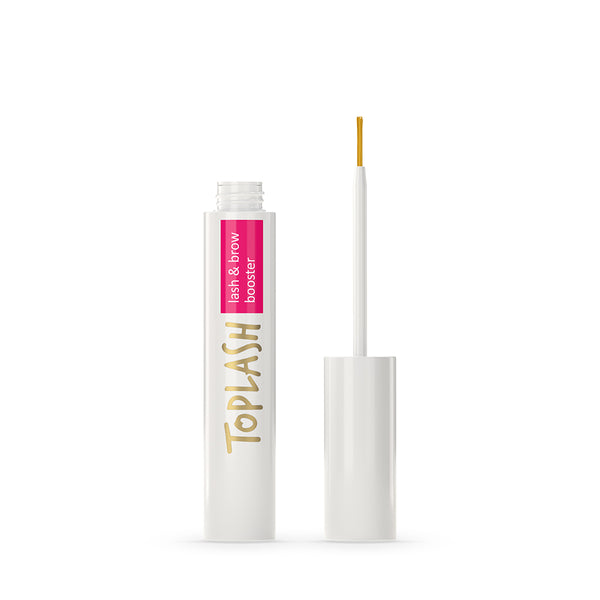
Recommended alternative — complete triple-peptide system
Toplash Lash & Brow Serum
★★★★★
The complete AT-3 + BTP-1 + MP-17 growth-peptide system with independent clinical data: +52.3% length and +31.9% volume at 8 weeks. Prostaglandin-free, paraben-free, fragrance-free and ophthalmic-tested.
Shop Toplash SerumFrequently Asked Questions
Can I use a lash serum if I have sensitive eyes?
Yes — but the formula matters greatly. Peptide-based serums without fragrance, alcohol, parabens or prostaglandin analogs are well-tolerated by most sensitive-eye users. Avoid PGA serums, which carry a ~10% rate of conjunctival hyperemia (red eyes). Start with every-other-day application and discontinue if burning or persistent redness occurs.
What lash serum ingredients cause the most irritation in sensitive eyes?
The most common irritants are: (1) prostaglandin analogs (ICP, DDDE, bimatoprost) — cause redness, itching and swelling; (2) synthetic fragrance — a broad allergen trigger; (3) alcohol (denatured or SD alcohol) — drying and stinging; (4) benzalkonium chloride (BAK) — preservative toxic to the ocular surface; (5) parabens and phthalates — secondary sensitisers. A clean peptide formula avoids all five.
Are prostaglandin lash serums worse for sensitive eyes?
Yes. Prostaglandin analogs cause conjunctival hyperemia in approximately 10% of users and periorbital oedema in roughly 4% — rates far higher than peptide serums, which show irritation profiles comparable to a plain hydrating serum. The 2026 SCCS Opinion SCCS/1680/25 confirmed that PGA compounds (ICP, DDDE, MDN) "cannot be considered safe," adding regulatory weight to the clinical signal.
Can I use a lash serum if I wear contact lenses?
Yes, with care. Always remove contact lenses before applying lash serum, and wait until the product has fully dried (15–20 minutes) before reinserting lenses. Residue from lash serum can cloud soft lenses and cause burning on contact with the ocular surface. Peptide-based, fragrance-free, BAK-free formulas are the safest choice for lens wearers.
How do I apply lash serum safely if I have sensitive eyes?
Apply to the upper lash line only — not the waterline or lower lashes. Use a single, thin stroke on clean, fully dry skin. Apply at night so closed eyes minimise migration. Start every other day for the first two weeks to assess tolerance. If no irritation occurs, move to nightly use. Never apply to the inner corner of the eye or on the eyelid skin.
What are the warning signs that a lash serum is too harsh for my eyes?
Stop using any lash serum if you experience: persistent redness or bloodshot appearance lasting more than 48 hours; burning or stinging that does not resolve within 30 minutes of application; swelling of the eyelid or surrounding skin; watery eyes or discharge; or any change in iris colour. Mild transient dryness in the first 1–2 days is normal; prolonged symptoms are not. Iris colour change, fat atrophy, or eyelid drooping require prompt ophthalmology assessment.
Does Toplash work for sensitive eyes?
Toplash is formulated without prostaglandins, fragrance, alcohol, BAK, parabens or phthalates — the five primary sensitising categories for sensitive-eye users. Its triple-peptide complex (MP-17, BTP-1, AT-3) works by signalling keratinocyte growth factor receptors rather than hormonal pathways, producing no known ocular surface effects. In an independent 8-week trial, +52.3% lash length and +31.9% volume were recorded with no ocular adverse events.
References
- Galor A, et al. "Epidemiology of ocular surface disease." Ophthalmology. 2011.
- Wand M, et al. "Latanoprost and iris, ciliary body, and eyelid pigmentation." J Glaucoma. 2001.
- Scientific Committee on Consumer Safety. Opinion SCCS/1680/25 on Isopropyl Cloprostenate, DDDE and MDN in cosmetic products. European Commission; 2 February 2026. View PDF
- Goldberg RA, et al. "Periorbital effects of cosmetic prostaglandin analogs." Ophthalmic Plast Reconstr Surg. 2009.
- Yam JCS, Yuen NS. "Iris color change associated with bimatoprost." J Ocul Pharmacol Ther. 2014.
- Toplash Cosmetics. Internal clinical trial data, 8-week independent study. 2025.
- Smart Vision Optometry. "Choosing Eyelash Serums Gentle on Sensitive Eyes." 2024.
- Hairfolli. "Best Safe Eyelash Growth Serum for Sensitive Eyes." 2025.
- Park Magazine NY. "Can You Use Lash Serum With Sensitive Eyes or Contact Lenses?" 2025.
- Ophthalmology24. "Lash Serum in the Eye: Risks and Irritation." 2025.