
Is Your Lash Serum Causing Dark Circles? Two Mechanisms Explained (2026)
Lash serums containing prostaglandin analogs can cause periorbital dark circles through two routes: skin hyperpigmentation and fat atrophy. Learn which is reversible, which isn't, and how to avoid both with a peptide-based formula.
Updated: June 20, 2026 Written by: Branda M. Heim Reviewed by: Branda M. Heim, Board-Certified Cosmetologist8 referencesView Toplash SerumYes — but only prostaglandin serums carry this risk. They can darken the under-eye area through two pathways: (1) periorbital hyperpigmentation — increased melanin in the thin eyelid skin, usually reversible on stopping; and (2) periorbital fat atrophy — reduced orbital fat volume creating shadows and hollowing, only partially reversible. Peptide serums have neither mechanism.
Dermatologists and oculoplastic surgeons began noticing an unusual pattern: patients who had used prostaglandin-based lash serums were presenting with unexpected periorbital ageing — darker, hollower eyes — rather than the bright-eyed look they sought. The mechanism was traced to two separate prostaglandin-driven effects on the periorbital anatomy.
If you have started a lash serum and noticed your under-eye area becoming darker or more sunken-looking, this guide will help you identify which mechanism is at play and what to do about it.
The Two Distinct Causes of Lash Serum Dark Circles
Understanding which type of darkening you are experiencing determines the appropriate response — because they have different prognoses:
Periorbital Hyperpigmentation
PGA compounds stimulate melanin production in the keratinocytes of the thin periorbital skin. The eyelids darken, sometimes extending to the under-eye area as migrated serum reaches the lower orbital zone via blinking and tear film circulation.
Appears as: uniform brownish darkening of eyelid skin; may extend to the upper cheek.
✓ Usually ReversiblePeriorbital Fat Atrophy
PGA compounds also act on orbital fat cells (adipocytes), promoting lipolysis (fat breakdown) and reducing orbital fat volume. This creates the appearance known as prostaglandin-associated periorbitopathy (PAP): hollowing, sunken upper sulcus, and shadows that read as dark circles.
Appears as: hollow, sunken orbit; deepened upper sulcus; under-eye shadows from structural volume loss.
⚠ Partially ReversibleHow to Tell Which Type You Have
A simple self-assessment can help distinguish pigmentation-driven from structure-driven darkening — though a dermatologist or ophthalmologist can provide a definitive assessment:
- Stretch test: Gently pull the under-eye skin taut with one finger. If the dark colour moves with the skin and remains visible when stretched, it is likely hyperpigmentation. If the darkening is a shadow in a hollow area that persists regardless of skin tension, fat atrophy is more likely.
- Mirror test from below: Tilt your head back and look at the under-eye area from slightly below. Shadows from hollowing change in character; surface pigmentation does not.
- Photographs vs current: Compare well-lit, consistent photographs from before serum use. Skin that is uniformly darker indicates hyperpigmentation; structural changes (hollowing, upper sulcus deepening, visible orbital rim) indicate fat atrophy.
- Onset timeline: Hyperpigmentation typically begins within weeks to a few months of use. Fat atrophy is more gradual — often first noticeable after 6–12 months of consistent PGA serum use.
Many users experience both simultaneously. A dermatologist experienced in periorbital anatomy can distinguish the contribution of each component and advise on appropriate treatment.
Which Serums Cause Periorbital Darkening?
Only serums containing prostaglandin analog compounds carry this risk. The following list covers the major cosmetic serums with known PGA content:
| Serum | PGA Ingredient | Risk Category |
|---|---|---|
| GrandeLASH-MD | Isopropyl Cloprostenate (ICP) | PGA — High Risk |
| RapidLash | Isopropyl Cloprostenate (ICP) | PGA — High Risk |
| LiLash | Isopropyl Cloprostenate (ICP) | PGA — High Risk |
| Babe Lash | Isopropyl Cloprostenate (ICP) | PGA — High Risk |
| NeuLash | Isopropyl Cloprostenate (ICP) | PGA — High Risk |
| RevitaLash Advanced | Dechloro Dihydroxy Difluoro Ethylcloprostenolamide (DDDE) | PGA — High Risk |
| Latisse (Rx) | Bimatoprost | PGA — Prescription |
| Toplash | MP-17, BTP-1, AT-3 (peptides only) | Peptide — No PGA Risk |
Important: Health Canada banned ICP from cosmetics in 2019. The 2026 EU Scientific Committee on Consumer Safety Opinion SCCS/1680/25 concluded that ICP, DDDE and MDN "cannot be considered safe for use in cosmetic products."[1] Serums containing these ingredients continue to be sold in some markets; consumers should check INCI labels carefully.
Reversibility: What You Can and Cannot Undo
The reversibility of PGA-induced periorbital changes differs significantly between the two mechanisms:
| Effect | Reversibility | Recovery Timeline | Treatment |
|---|---|---|---|
| Periorbital skin hyperpigmentation | Usually reversible | Weeks to a few months after stopping | Stop product; niacinamide, tranexamic acid, arbutin; sun protection |
| Periorbital fat atrophy (PAP) | Only partially reversible | Slow partial improvement over months; full resolution not documented | Stop product; hyaluronic acid filler or fat transfer for volume restoration |
| Upper sulcus deepening | Partially reversible | Dependent on degree; mild cases may improve over 6–12 months | Stop product; oculoplastic consultation for significant cases |
| Conjunctival hyperemia (red eyes) | Fully reversible | 1–2 weeks after stopping | Stop product |
What to Do If Your Lash Serum Is Causing Dark Circles
-
Stop the PGA serum immediately
Continued use will deepen existing hyperpigmentation and extend the period of fat loss. Stopping is the single most effective action. The lash enhancement benefit will fade over 2–4 months (normal cycle reset), but progression of the dark circles will stop.
-
Switch to a peptide serum to preserve lash gains
A peptide-based serum applied to the lash line during the PGA washout period maintains lash appearance while avoiding further prostaglandin exposure. Peptides carry no periorbital fat or melanin-stimulation risk.
-
Address hyperpigmentation with brightening actives
Under-eye brightening serums containing niacinamide 5%, tranexamic acid, or arbutin inhibit melanin transfer and can reduce periorbital hyperpigmentation. Clinical data show these ingredients reduce periorbital pigmentation by up to ~48% with twice-daily use over 8–12 weeks.[2] Use SPF daily to prevent UV-driven re-darkening.
-
Consult a dermatologist or oculoplastic surgeon for fat atrophy
If hollowing or a sunken appearance persists after stopping the serum and allowing 3–6 months for partial natural recovery, seek a specialist opinion. Hyaluronic acid filler or autologous fat transfer can restore orbital volume. Avoid repeating the error with a different PGA product post-treatment.
-
Apply SPF daily to the periorbital zone
UV radiation accelerates all forms of periorbital hyperpigmentation and may exacerbate fat volume loss. SPF 30+ applied daily to the orbital area (including the upper eyelid crease) is a key maintenance step both during recovery and going forward.
"Patients often come in having used a lash serum for months, puzzled as to why they look more tired and aged than they did before starting it. The answer is usually prostaglandin-associated periorbitopathy: a combination of skin darkening and fat atrophy. The tragedy is that the lash results — which are real — come at the cost of the eye area's overall youthful appearance. A peptide serum achieves comparable lash results without touching the fat or the melanocytes."
Why Peptide Serums Do Not Cause Dark Circles
Peptide-based lash serums work by signalling keratinocyte growth factor (KGF) receptors in the dermal papilla of the follicle. This mechanism is entirely local to the hair follicle itself:
- No prostaglandin receptor activity — cannot stimulate orbital fat lipolysis
- No melanocyte stimulation — cannot increase periorbital melanin
- No FP receptor binding — no systemic hormonal pathway
Toplash's triple-peptide complex (MP-17, BTP-1, AT-3) is specifically designed around this follicle-targeted mechanism. In an independent 8-week trial, +52.3% lash length and +31.9% volume were achieved with no periorbital adverse effects reported.[3]
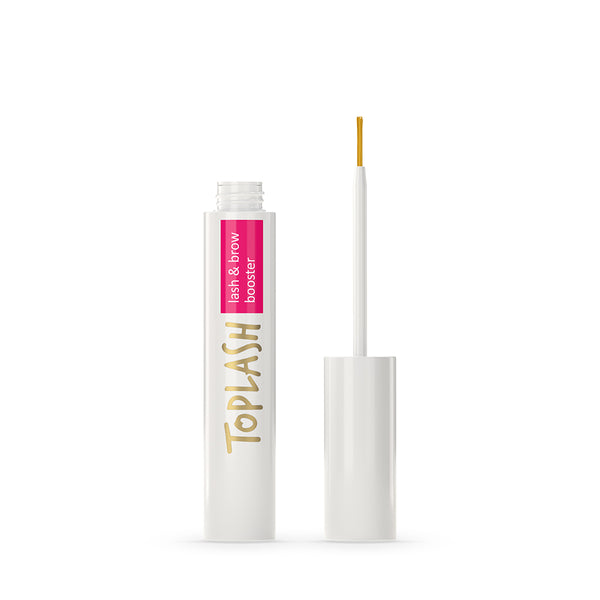
Toplash Lash & Brow Serum
The complete AT-3 + BTP-1 + MP-17 growth-peptide system with independent clinical data: +52.3% length and +31.9% volume at 8 weeks. Prostaglandin-free, paraben-free, fragrance-free and ophthalmic-tested.
Shop Toplash SerumFrequently Asked Questions
Can a lash serum cause dark circles under the eyes?
Yes — but only serums containing prostaglandin analogs (ICP, DDDE, bimatoprost). They cause dark circles through two mechanisms: periorbital skin hyperpigmentation (usually reversible) and periorbital fat atrophy (only partially reversible). Peptide serums have neither mechanism.
What is the difference between lash serum dark circles from hyperpigmentation vs fat loss?
Hyperpigmentation is surface skin darkening — the eyelid and periorbital skin produces more melanin. Fat atrophy is structural — the orbital fat pad reduces in volume, creating hollowing and shadows. Hyperpigmentation appears as uniform skin darkening; fat atrophy appears as a sunken, hollowed eye area with structural shadows. Both can co-exist.
Will dark circles from lash serum go away after stopping?
Periorbital hyperpigmentation typically fades within weeks to a few months after stopping, especially with brightening actives (niacinamide, tranexamic acid). Fat atrophy shows only partial recovery — structural hollowing may require filler or fat transfer for complete correction. Stop the product first and allow 3–6 months for natural recovery before considering intervention.
How do I know if my dark circles are from hyperpigmentation or fat loss?
Do a stretch test: pull the under-eye skin taut. If the darkness moves with the skin and stays visible when stretched, it is hyperpigmentation. If the darkness is a shadow in a hollow that persists regardless of skin tension, fat atrophy is more likely. A dermatologist or oculoplastic surgeon can assess both components definitively.
Can I treat lash serum dark circles while still using the serum?
If caused by a PGA serum, continuing use will worsen or maintain the pigmentation. Brightening treatments (niacinamide, tranexamic acid, arbutin) may reduce the hyperpigmentation component somewhat, but complete resolution requires stopping the causative product. Switch to a peptide serum to maintain lash results while allowing recovery.
Do peptide lash serums cause dark circles?
No. Peptide serums contain no prostaglandin analogs and have no mechanism for stimulating periorbital melanin production or reducing orbital fat. Toplash's triple-peptide formula (MP-17, BTP-1, AT-3) produced no periorbital adverse effects in an independent 8-week clinical trial.
Which lash serums are known to cause periorbital darkening?
Serums containing prostaglandin analogs: GrandeLASH-MD (ICP), RapidLash (ICP), RevitaLash Advanced (DDDE), LiLash (ICP), Babe Lash (ICP), NeuLash (ICP), and prescription Latisse (bimatoprost). Health Canada banned ICP from cosmetics in 2019; the 2026 EU SCCS Opinion SCCS/1680/25 concluded ICP, DDDE and MDN are unsafe in cosmetics.
References
- Scientific Committee on Consumer Safety. Opinion SCCS/1680/25 on Isopropyl Cloprostenate, DDDE and MDN in cosmetic products. European Commission; 2 February 2026. View PDF
- Huang Y, et al. "Clinical Efficacy of a Novel Topical Formulation on Periorbital Dark Circles: An Objective Analysis." PMC. 2025. PMC12235579.
- Toplash Cosmetics. Internal clinical trial data, 8-week independent study. 2025.
- Goldberg RA, et al. "Periorbital fat atrophy: an under-recognised side effect of topical prostaglandin." Ophthalmic Plast Reconstr Surg. 2009.
- Marie Claire UK. "This Ingredient in Your Favourite Lash Growth Serum Could Be Causing Dark Circles and Hyperpigmentation." 2024.
- Mindbodygreen. "Does Eyelash Serum Cause Dark Circles? A Doctor Explains." 2025.
- Divine Lashes. "Does Eyelash Serum Cause Dark Circles? The Truth Exposed." 2024.
- Health Canada. Cosmetic Ingredient Hotlist — Isopropyl Cloprostenate (ICP), banned 2019. View Hotlist